Friday, May 8, 2015

Teaching students to be curators of their own content

Quite a bit of what I read online are pieces that have been remixed and re-purposed.  It’s content that has been taken from various places on the web, then collected and organized, or “curated,” by someone other than the original author of that content.  It’s a form of composition that is definitely real-world, but until this year, it wasn't a format I had given much thought to inviting my students to write.  


Asking student writers to curate, though, is a worthwhile venture.


In addition to being an authentic, curation also has value because it gives students a chance to engage with web stuff differently than the passive-reader role we often ask them to take on.  When we invite our students to curate, they can speak back to and narrate the importance of what others have posted.  We enable them to view web content as a conversation where they can participate and invite others to listen in.


In the case of my class, the content that I planned to ask students to curate was their classmates’ work posted in a g+ community, titled Making STEAM, that we and several other schools use to share our STEAM focused “makes.” I wanted students to “round-up” collections of pieces that were unique, important, or spoke to them in some way, thus giving greater depth to what was happening in this online space.  Through writing and sharing round-ups, students' words would narrate unique stories of learning taking place, and conversely, student makers would see new significance to the content they posted by seeing it reflected and discussed by their classmates.


The challenge for me was figuring out how to teach curation as particular form of composition.  Like any other type of writing, it’s a form with a certain set of conventions.  I needed to familiarize my students with them and craft an assignment that contained enough parameters to guide but without the rigidity that could limit creativity and the myriad of exciting directions that this activity could take.


My plan went something like this:


Part 1: Inquiry into Round-Up (35 minutes)


I shared the following set of round-up posts with students, and assigned them each one to read. As they read, I asked them to think about what the writer is doing in this piece.


   TUESDAY ROUND-UP: MARSHAWN LYNCH CALLS INTO 'THE BARBERSHOP' ON 710 ESPN SEATTLE


  The Weekly Round Up (from the Rhode Island Monthly Newsletter)


After reading, students met with others who read the same post and discuss:
  • What was the post about?
  • How was it organized?


Each group took a turn presenting their responses to these questions to the class, and students not in that group pulled up the post being discussed on their computers so that they could see the post the group was talking about.  Students could also share aspects that they noticed the group left out of their presentation.


After all groups presented and all students were exposed to all roundups, students got back into groups to discuss:
  • What did the round-ups have in common?
  • How were the round-ups different?
  • What sort of things happen in a round-up
  • What doesn’t happen in a round-up?


Share out and make a list on butcher paper of the last two bullets.  Below is a typed up version of what one of my classes came up with:


Round-ups do:
-explain what is being rounded up
-have a point, focus, or argument
-use stuff made by other people
-include text, images, tweets, videos
-have hyperlinks to sources used
Round-ups don’t:
-have random, disconnected stuff
-have long paragraphs
-use really formal language
-use really informal language
-contain spelling errors
-have outdated news


Part 2: Making STEAM Round-up Writing  (1-2 hours)


I explained to students that they would be creating their own round-ups, curating the content posted in our G+ community.  This assignment was about them telling the story of something important that they noticed happening in what people were doing and saying in the Making STEAM community. It was up to them to decide which posts they would select and what they would say about them.  


These were the requirements I gave them (the amount of artifacts and to include was something that we negotiated as a class):


Write a post that curates a collection of postings made in our G+community.
Should include:
  • 3-5 (5-7 if with a partner) posts from the Making STEAM community (screenshots and links)
  • Your commentary on those posts (what they have in common, what you find interesting about them, why they matter, etc)
Format: You decide--Google Slideshow, Google Doc, Prezi, Blog Post,  something else?
Publish your roundup on G+ Making STEAM community under the “Curation and Reflection” category.  Include a brief description of what your round-up is about and be sure to tag any students whose work you featured in it (type +their name).


I also shared this doc with them as a reference for the requirements of the assignment and a how-to of posting to g+


----


After two days of students mostly working by themselves, and sometimes with partners, most completed roundups and had them posted in our g+ space under the category of curation and reflection. As I had hoped, these round-ups took all sorts of directions (though most students chose to use the same tool (Google Slides) to create them.  
My next project is to round-up these round-ups, examining the sorts of things that students did through them.  Stay tuned….

Monday, April 20, 2015

Huck Finn Meets a Sound Booth

Earlier this month Randy Kurstin's students from Albemarle Road Middle School had the chance to use the sound booth at Imaginon.  They connected that up with GoAnimate.  Check out what they did here.


Sunday, February 15, 2015

Animal Toy Hack: Re-imagining what's Possible in Science and Literacy

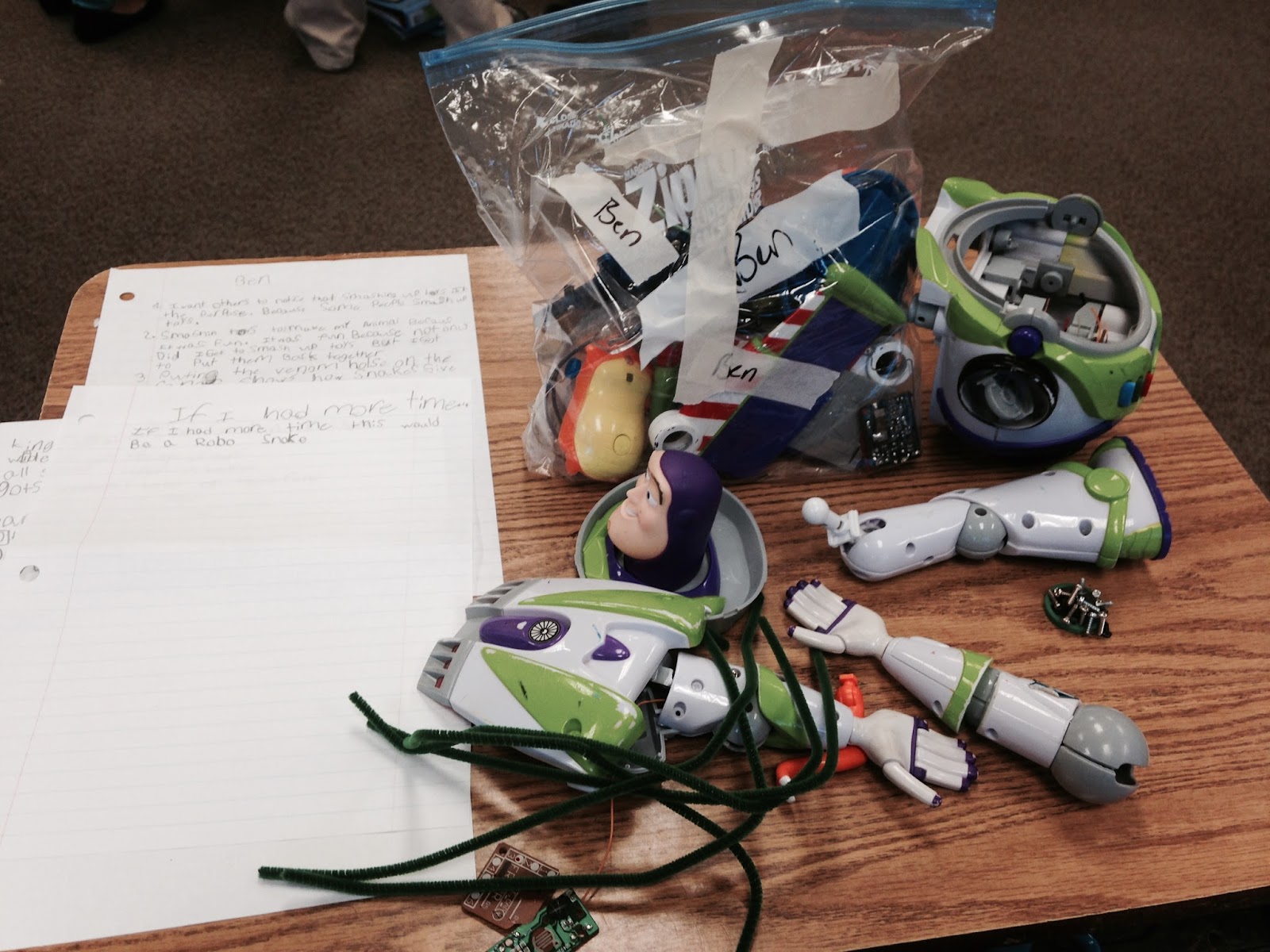
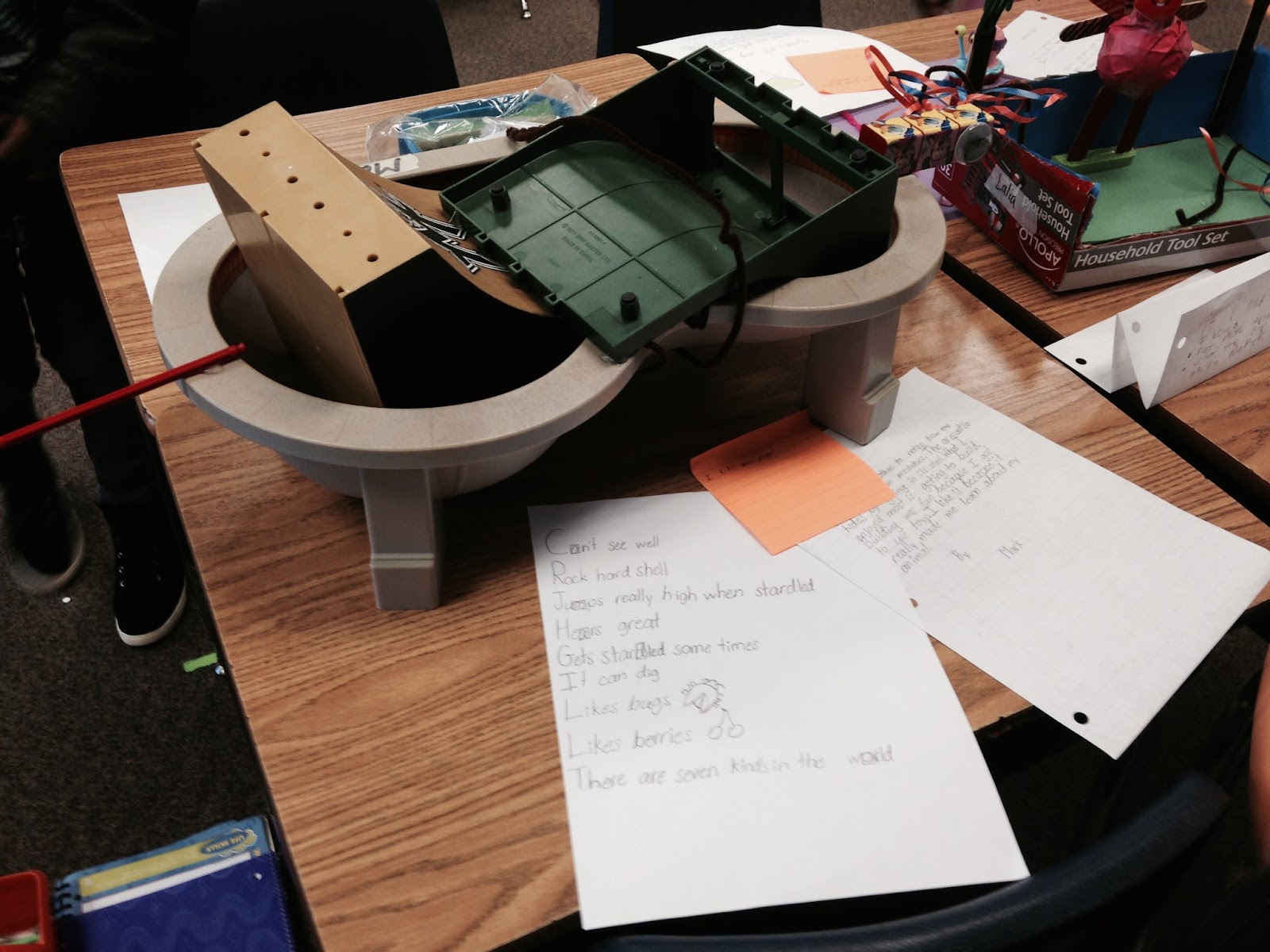
It’s Tuesday morning. MAKER day. Maggie (my current Discovery Place thinking partner) came to class with Michael (Discovery Place educator and my thinking partner from last year). Together, the three of us explained to the class that this morning we were going to have them use the leftover toys from the toy hack (an out of school event held at Discovery Place just a few days prior) to create a representation of the animal they have been researching for our animal adaptations Science unit. This created tremendous "buzz" in the room along with important questions.

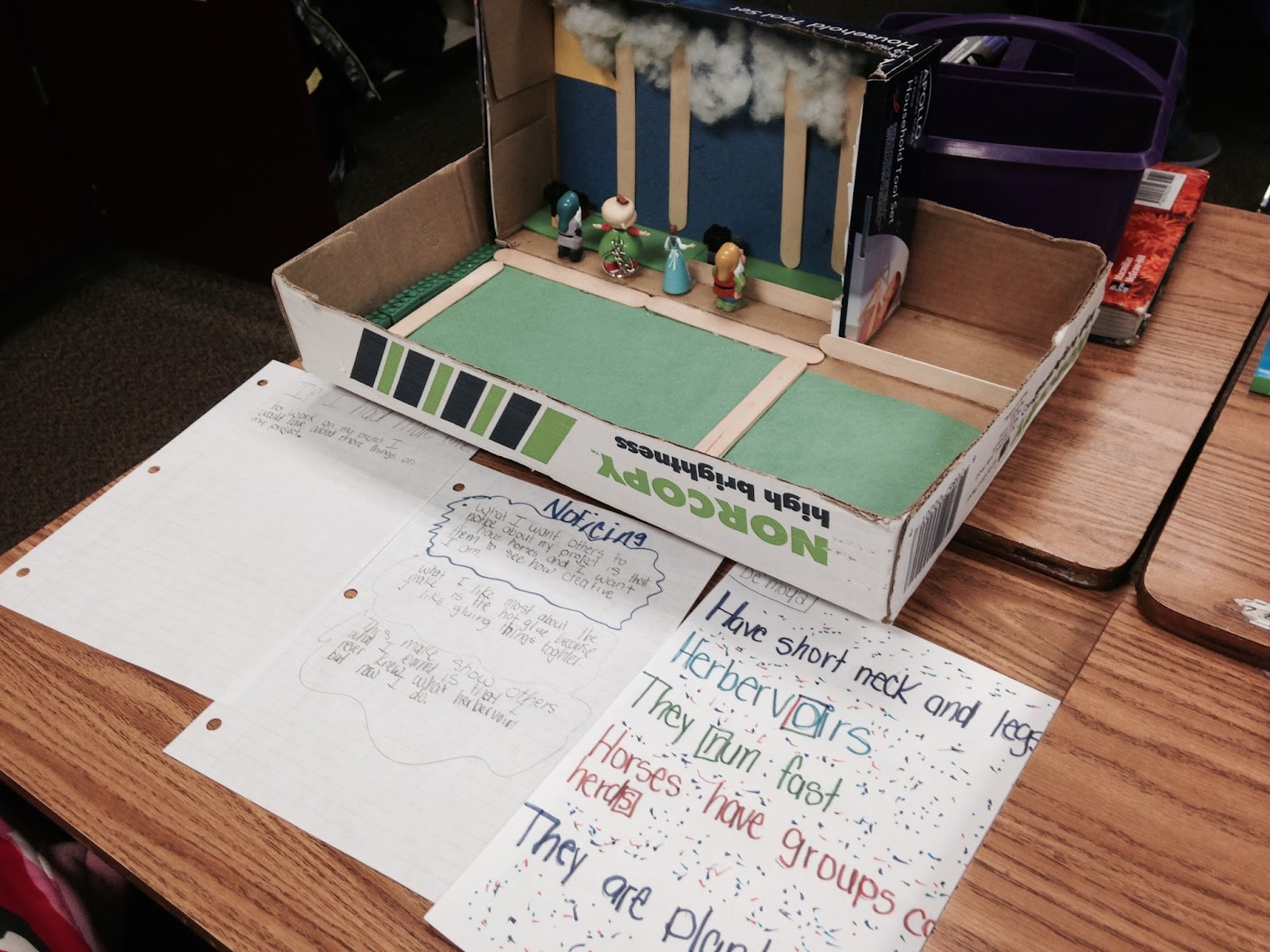
With the “buzz” came a bit of uncertainty. The students weren't quite sure what we meant by a "representation of their animal." So, we explained to them that a representation meant that their project would not necessarily look exactly like the animal they had spent time researching but that it would resemble it based on choices they made regarding the toys they used. I could still sense that the students were feeling a little tentative so I provided an image of possibility, with the help from De’Moya, one of my students. I asked her to tell the class which animal she had been researching. She replied, “A horse.” I asked to tell the group one thing she learned about horses. She stated that, “Horses have strong legs.” I asked her to come over to the pile of used toys and pick something out that might give us an idea of how strong a horse’s legs are. After scanning what was available, she picked up a plastic robot. I asked her to tell the class why she picked this toy up. She proceeded to tell her classmates that the legs of the robot looked strong; like the legs of a horse. This made total sense to the rest of the class.

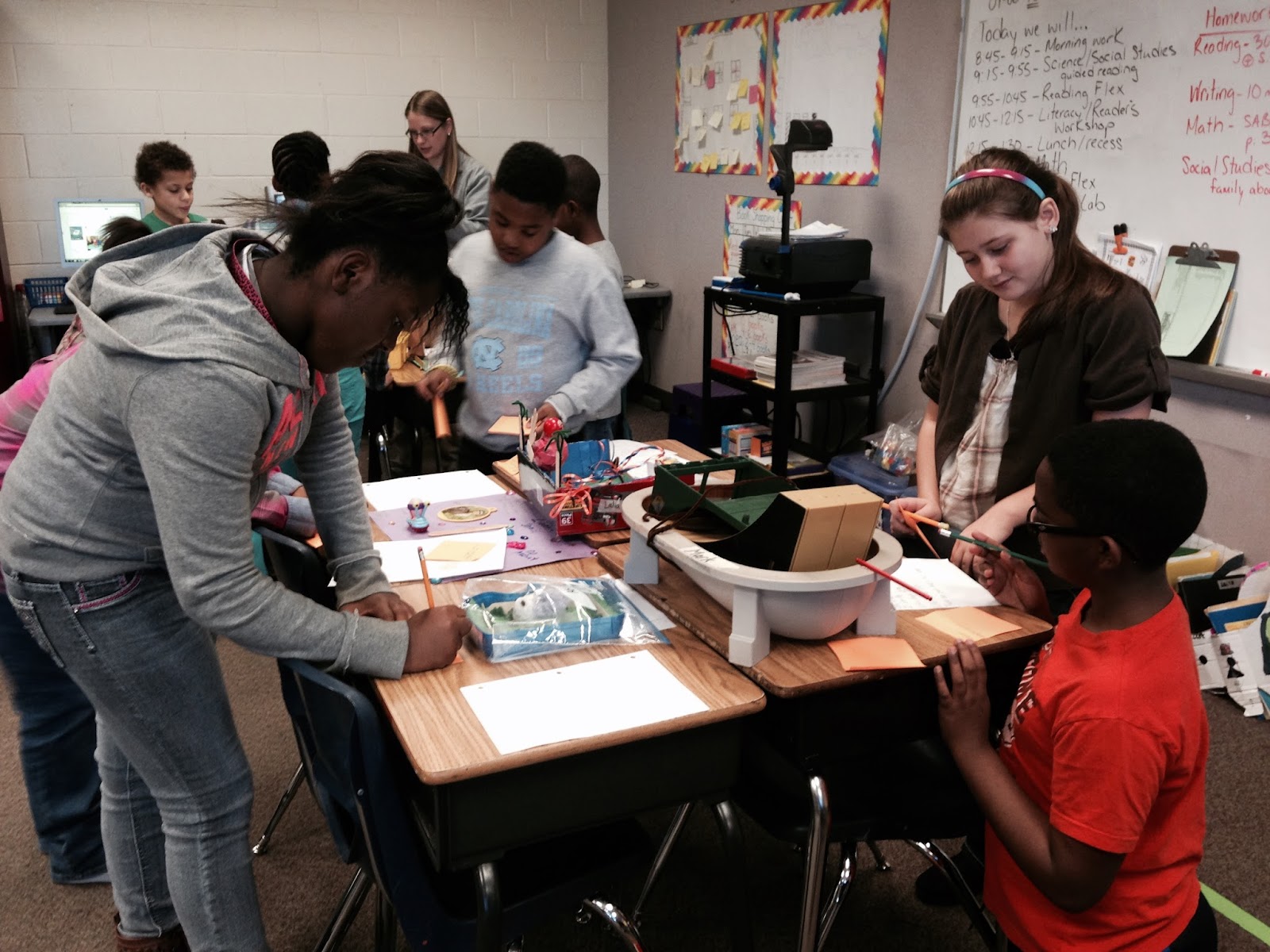
With a firm understanding of the term representation we encouraged the students to look back through the notes they had taken about their animal, to think about things they would want others to know about the animal, and to pick out toys they thought would help them best represent the things they wanted to share that they had learned. The students enthusiastically began to look back over the notes they had captured about their animal; notes taken (in previous class sessions) from books they had checked out from the library, notes taken from sites on the Internet, and notes taken from the textbook; specifically a section that featured different types of animal adaptations as well as the learned and evolutionary behaviors that animals act out for a variety of reasons. Over the course of the next 3 weeks, 5, 90 minute sessions, the classroom transformed into a miniature workshop. Maggie and Michael brought both their expertise and understanding of animal adaptations along with tools for the kids to use. The students continued to look back at their notes, thinking about what they had learned as well as what they wanted the representation of their animal to communicate, "shopping" for the combination of toys that would help them out. I have never seen a more engaged group of students work on a project than I did during this one.

Each session brought with it new and exciting realizations. Without being prompted to do so, the students organically started seeing the value of “real time” problem solving, often times collaborating with one another, sharing materials, helping each other MAKE their projects become a reality. They talked to each other (peer to peer in combinations that do not occur under “normal” circumstances) about decisions that were working and not working. They revised their projects in “real time” based on the problem solving, collaborating,  and conversations. In the end almost everyone had something they could call "finished." As the MAKE portion of this project came to a close Maggie, Michael, and I started thinking about how we wanted to celebrate all that had transpired.

We decided that we would do a gallery crawl. This would involve the students rotating around the room, table to table viewing and commenting (via sticky notes) on each other's projects. We wanted the students to have more than just their representation to share so we started thinking about some writing that would pull the whole thing together. We decided to have them write an informational acrostic poem about their animal and a reflective paragraph that had the students think about the following, 1) Describe one thing you want others to focus on when they view your representation and state why, 2) Talk about your favorite part of the entire process...from reading and note taking to making your representation, and 3) Talk about how this MAKE shows others what they have learned.

Now, some of the students were not fully ready for this gallery crawl as they actually did not "finish" their representation of their animal. These students spent a majority of their MAKE time tinkering and trying to figure things out. I had to be ok with this. The journey was more important than the destination! One of the main tenants of MAKE is the notion of tinkering; having time to play around, in this case with the materials (used toys and tools) that were presented to the students. Being “ok with this” rubs against “the weeds” that we as teachers get “caught up in” over the course of a “normal” school day; that being, getting kids to finish their work so it can be evaluated so we are ready to report out that learning is/not taking place. Getting “caught up in” these “weeds” is no one person’s fault as much as it is a consequence of little to no time at all to reflect collectively on the expectations placed on ALL stakeholders in education charged with preparing children to become productive citizens in our society upon graduation; a topic for a future resource maybe!

1/7/15 - 25

However, if one or more of these stakeholders were to remove themselves from “the weeds” s/he would see that the essence of this project includes several components of the Common Core is currently asking of us; namely the cultivation of inquiry and critical thinking through the tinkering process. During these moments of tinkering, as things were/not coming together, the students were learning. They were learning how to take risks and test theories out with the materials we presented to them. From these risks and tests came success and failure. Students realized that some materials worked better with each other than others, that one tool would assist them in ways that others could not, and that it was ok to seek help from the person next to you, even if that meant interrupting them from their own work. The images included in this resource highlight what was learned throughout this MAKE and as I type these words I cannot help but think what might happen if I myself embraced wholly the MAKE process described here; this notion of tinkering, into the traditional spaces of the instructional day?

1/7/15 - 10

1/7/15 - 18


In an effort to help all of the students see the value in what they had learned through their tinkering with the toys "finished" or “not,” we asked them to look at what they had “completed” and reflect (in writing) on what they would do if they had more time. The reflection, like the two other pieces of writing, gave the students the opportunity to look back at all of the amazing work they DID complete; understanding that with any project, there comes a point when it needs to be abandoned, making room for the next learning experience. We asked the students to think of this reflection in this way so that when people came into the class and or to their desk to view their work, they had a “complete” vision of what they were looking at.


1/7/15 - 3


The gallery crawl was scheduled for one, 90 minute session so we could explain to the students what was expected and give them a decent amount of time to view and respond to each other's work. Students rotated around the room in groups of 4, viewing all of the amazing work that they made. Armed with sticky-notes and pencils, they commented and questioned what they saw and read. When the gallery crawl was finished, each student returned to their seat and read through the comments/questions that others had left for them. We then asked if anyone would be willing to share with the group what others had written to them. Even though the kids had the option to leave anonymous remarks many of them signed their names and each student that shared a sticky note from a classmate made sure we knew who the comment/question was coming from. They were so proud of themselves and delighted with what their classmates had to say to them about their work! The whole group sharing that followed the gallery crawl was very emotional in that the students were bonding with each over a project that included so much; reading, writing, thinking, sharing, collaborating, MAKING. It was overwhelming in a very positive way!

Saturday, January 31, 2015

Clinkity, clink, clink: Extended Inquiry into Marble Mazes

Last year I came to school one day to see a giant marble maze created with blocks by two older boys.  It made the most pleasant sound as the marble got to the bottom: clinkity, clink, clink!  There are these kinds of pivotal learning moments that stick in the minds of the kids even this year.   The other day I heard a younger student, who started this fall and hasn’t met the older kiddos very often, referencing “the day Tino made the awesome  marble maze.”

Marble mazes have become part of the culture the group of 2 to 8 year olds in our play based early childhood program.  This year one of the oldest kiddo in our crew (age 7) began making marble mazes early in the school year.  With lots of time trying this out at the block center another kiddo latched into this idea quickly.  For at least two months there were marble mazes built every day.  They were built inside with unit blocks, with miniature unit blocks inside and and outside and outside with hollow blocks.

Following this interest Carla, our Discovery Place partner, and I brought in more materials that might extend the interest.  We made marble paintings, tried a pre-made marble maze kit, made our own felt balls and used cardboard and straws to create labyrinth style marble mazes.

It's been exciting to see all that has happened just around this one concept.  It really has become a collaborative extended inquiry.  Here are some of the things I noticed along the way!

Lots of physics is involved in block play and building generally.  As kids manipulated blocks, cardboard or pre-made pieces they had to think about how the materials worked together, what would create sturdy pathways and walls.  They decided which kinds of blocks or other materials would work for specific purposes.  As they played more and more with the marbles, they developed understandings of force, movement, and incline.  They tried different kinds of balls, too: felt balls, beads and wooden balls.  They had discussions about the weight of the balls, the size and the smoothness of the surfaces and how this changed the way the mazes worked.  They explored symmetry as they created two sides of the maze or two tracks side by side.  They explored length and measurement as they tried to see and describe to others how far certain inclines would allow balls to roll and as they found ways to articulate to each other how long a certain part of the maze or even a certain block needed to be (i.e. "Hand me the long one.  No, the one that is like two of these.")

And there were overarching learning ideas in constant play, too, particularly this inquiry made space for iteration, revision and mentoring from one another.  They revised the mazes in the moment as they went.  Usually a child would begin building and at some point would stop to try rolling the marble to see how things were going.  Then back to building to make changes.  Eventually they would declare the maze as ready or done and often get someone to come over to see how the marble rolled.  Sometimes this sharing process would lead to more changes.  Sometimes something unexpected happened during the share and kids went back to the drawing board.  Sometimes another child coming to see would have an idea for improvement or just something different and they would try this out together.  Very often multiple kids worked in the area on various mazes.  They watch what others are doing and try the ideas out themselves.

They also hold the old mazes they have seen in memory and try them again next time.  I guess this is the thing about the extended inquiry.  This interest continued over months.  So the kids were iterating all the time, trying the ideas again and agin.  They were able to build on their own attemps, on what they saw other kids do and even on the lore of last year :) Overtime I saw marble mazes change from a long flat structure to ones with multiple pathways, two side by side tracks, high rise mazes, large scale mazes, mazes with obstacles.  Something like adding obstacles spread through the group, until this idea was common knowledge.

Ideas from the marble maze inquiry spread wings in new spin off projects, too.  The kids started making obstacle courses with large hollow blocks, chairs and boxes.  Carla and the kids even made a rat maze for the Discovery Place rat, Patsy (now renamed by the kids as “Petsy”). They used blocks to build a maze with multiple paths and areas for Patsy to find carrots.


The social goes hand in hand with all of this (of course!!!).  I saw how marble mazes worked to build relationships between children and among the whole group.  As the marble maze inquiry continued and was shared, every child was involved at some point and so the inquiry became a point of cultural connection that was important in our transformation into a gelled community from opening of school into the fall.  The reason the interest became an extended inquiry is because the kids felt connected to the ideas and the other people playing around with it.   It's always back to the social-emotional :)