Earlier this month Randy Kurstin's students from Albemarle Road Middle School had the chance to use the sound booth at Imaginon. They connected that up with GoAnimate. Check out what they did here.
Monday, April 20, 2015

Sunday, February 15, 2015
Animal Toy Hack: Re-imagining what's Possible in Science and Literacy
It’s Tuesday morning. MAKER day. Maggie (my current Discovery Place thinking partner) came to class with Michael (Discovery Place educator and my thinking partner from last year). Together, the three of us explained to the class that this morning we were going to have them use the leftover toys from the toy hack (an out of school event held at Discovery Place just a few days prior) to create a representation of the animal they have been researching for our animal adaptations Science unit. This created tremendous "buzz" in the room along with important questions.
With the “buzz” came a bit of uncertainty. The students weren't quite sure what we meant by a "representation of their animal." So, we explained to them that a representation meant that their project would not necessarily look exactly like the animal they had spent time researching but that it would resemble it based on choices they made regarding the toys they used. I could still sense that the students were feeling a little tentative so I provided an image of possibility, with the help from De’Moya, one of my students. I asked her to tell the class which animal she had been researching. She replied, “A horse.” I asked to tell the group one thing she learned about horses. She stated that, “Horses have strong legs.” I asked her to come over to the pile of used toys and pick something out that might give us an idea of how strong a horse’s legs are. After scanning what was available, she picked up a plastic robot. I asked her to tell the class why she picked this toy up. She proceeded to tell her classmates that the legs of the robot looked strong; like the legs of a horse. This made total sense to the rest of the class.
With a firm understanding of the term representation we encouraged the students to look back through the notes they had taken about their animal, to think about things they would want others to know about the animal, and to pick out toys they thought would help them best represent the things they wanted to share that they had learned. The students enthusiastically began to look back over the notes they had captured about their animal; notes taken (in previous class sessions) from books they had checked out from the library, notes taken from sites on the Internet, and notes taken from the textbook; specifically a section that featured different types of animal adaptations as well as the learned and evolutionary behaviors that animals act out for a variety of reasons. Over the course of the next 3 weeks, 5, 90 minute sessions, the classroom transformed into a miniature workshop. Maggie and Michael brought both their expertise and understanding of animal adaptations along with tools for the kids to use. The students continued to look back at their notes, thinking about what they had learned as well as what they wanted the representation of their animal to communicate, "shopping" for the combination of toys that would help them out. I have never seen a more engaged group of students work on a project than I did during this one.
Each session brought with it new and exciting realizations. Without being prompted to do so, the students organically started seeing the value of “real time” problem solving, often times collaborating with one another, sharing materials, helping each other MAKE their projects become a reality. They talked to each other (peer to peer in combinations that do not occur under “normal” circumstances) about decisions that were working and not working. They revised their projects in “real time” based on the problem solving, collaborating, and conversations. In the end almost everyone had something they could call "finished." As the MAKE portion of this project came to a close Maggie, Michael, and I started thinking about how we wanted to celebrate all that had transpired.
We decided that we would do a gallery crawl. This would involve the students rotating around the room, table to table viewing and commenting (via sticky notes) on each other's projects. We wanted the students to have more than just their representation to share so we started thinking about some writing that would pull the whole thing together. We decided to have them write an informational acrostic poem about their animal and a reflective paragraph that had the students think about the following, 1) Describe one thing you want others to focus on when they view your representation and state why, 2) Talk about your favorite part of the entire process...from reading and note taking to making your representation, and 3) Talk about how this MAKE shows others what they have learned.
Now, some of the students were not fully ready for this gallery crawl as they actually did not "finish" their representation of their animal. These students spent a majority of their MAKE time tinkering and trying to figure things out. I had to be ok with this. The journey was more important than the destination! One of the main tenants of MAKE is the notion of tinkering; having time to play around, in this case with the materials (used toys and tools) that were presented to the students. Being “ok with this” rubs against “the weeds” that we as teachers get “caught up in” over the course of a “normal” school day; that being, getting kids to finish their work so it can be evaluated so we are ready to report out that learning is/not taking place. Getting “caught up in” these “weeds” is no one person’s fault as much as it is a consequence of little to no time at all to reflect collectively on the expectations placed on ALL stakeholders in education charged with preparing children to become productive citizens in our society upon graduation; a topic for a future resource maybe!
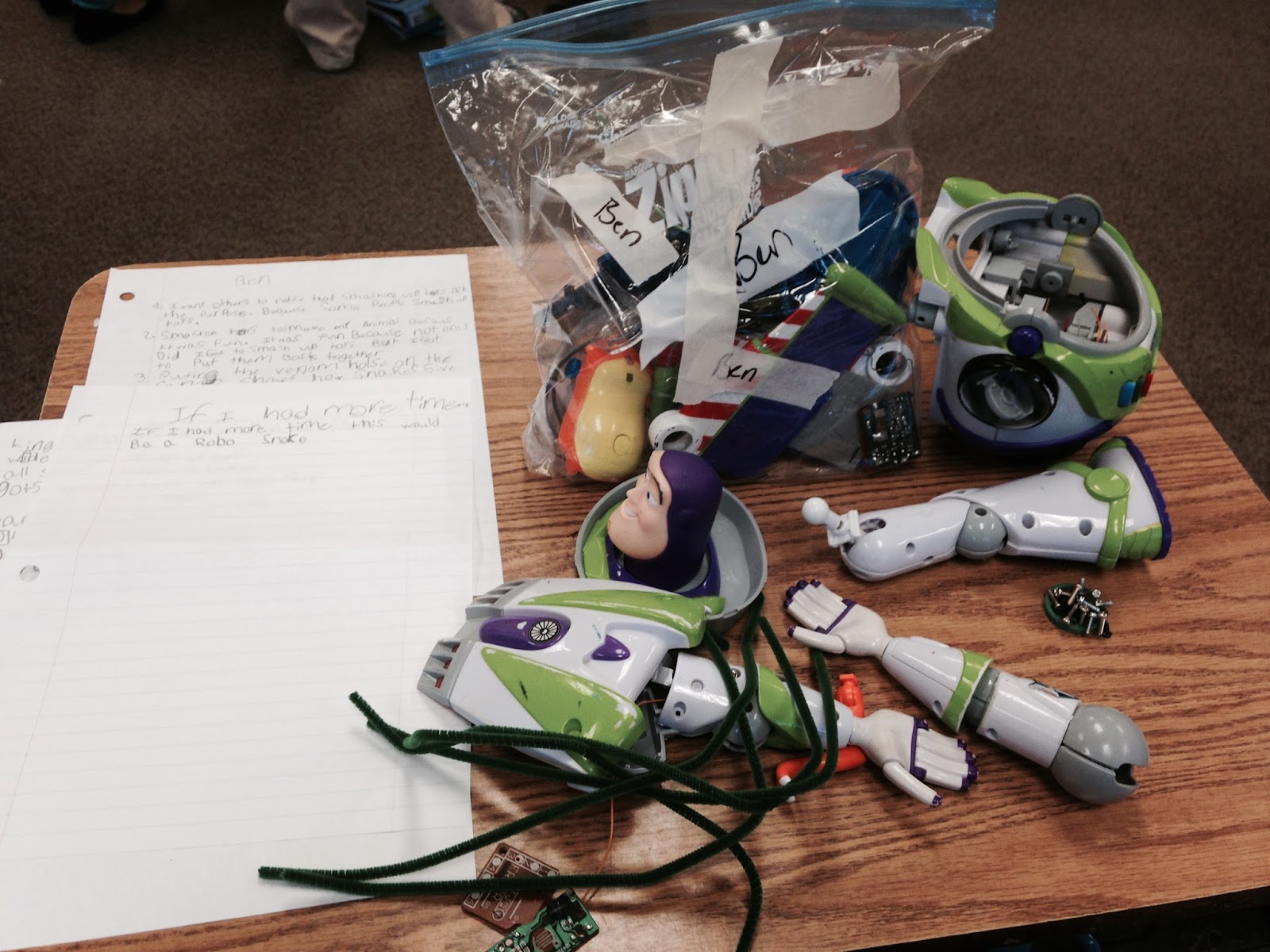
However, if one or more of these stakeholders were to remove themselves from “the weeds” s/he would see that the essence of this project includes several components of the Common Core is currently asking of us; namely the cultivation of inquiry and critical thinking through the tinkering process. During these moments of tinkering, as things were/not coming together, the students were learning. They were learning how to take risks and test theories out with the materials we presented to them. From these risks and tests came success and failure. Students realized that some materials worked better with each other than others, that one tool would assist them in ways that others could not, and that it was ok to seek help from the person next to you, even if that meant interrupting them from their own work. The images included in this resource highlight what was learned throughout this MAKE and as I type these words I cannot help but think what might happen if I myself embraced wholly the MAKE process described here; this notion of tinkering, into the traditional spaces of the instructional day?
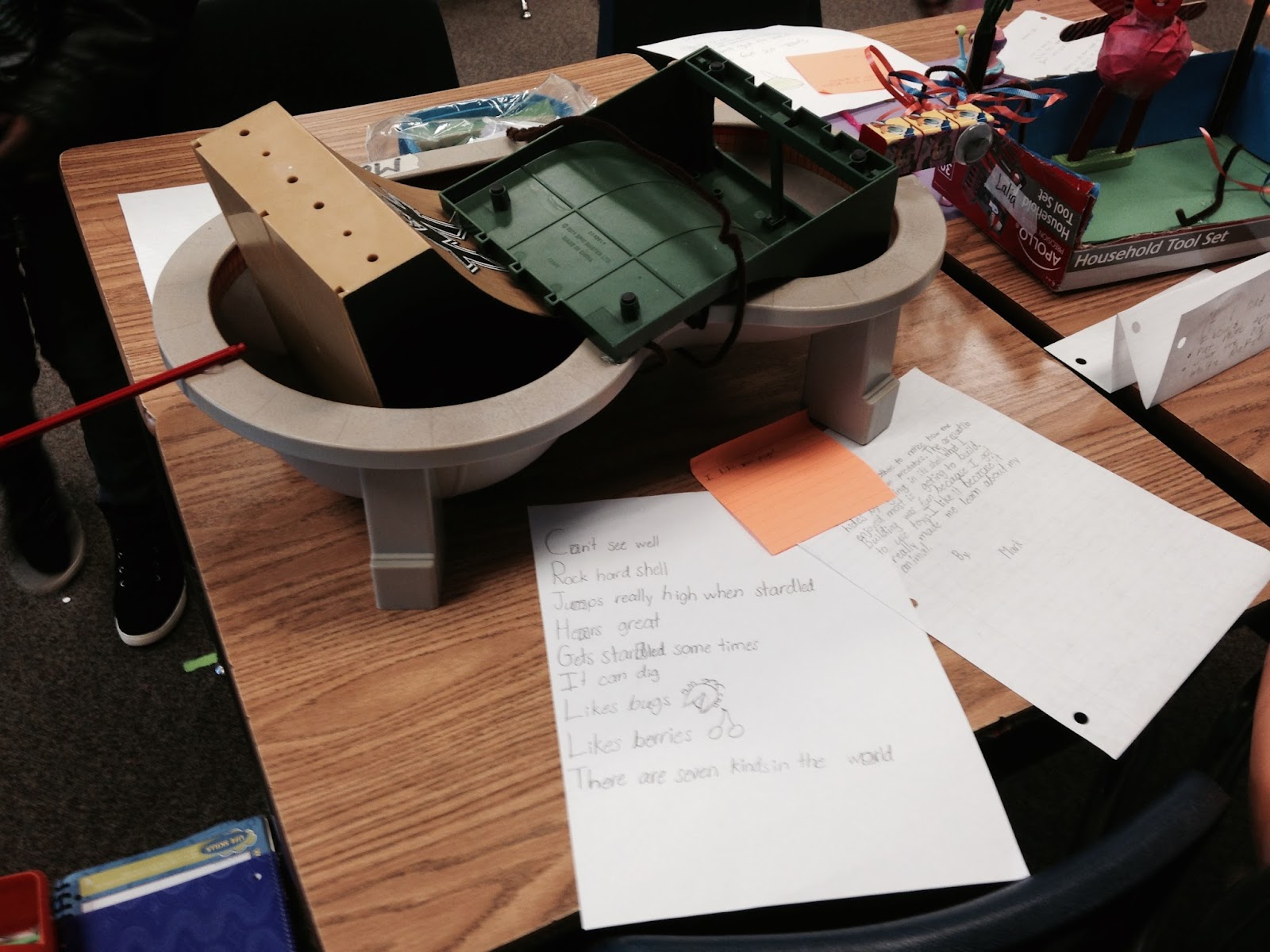
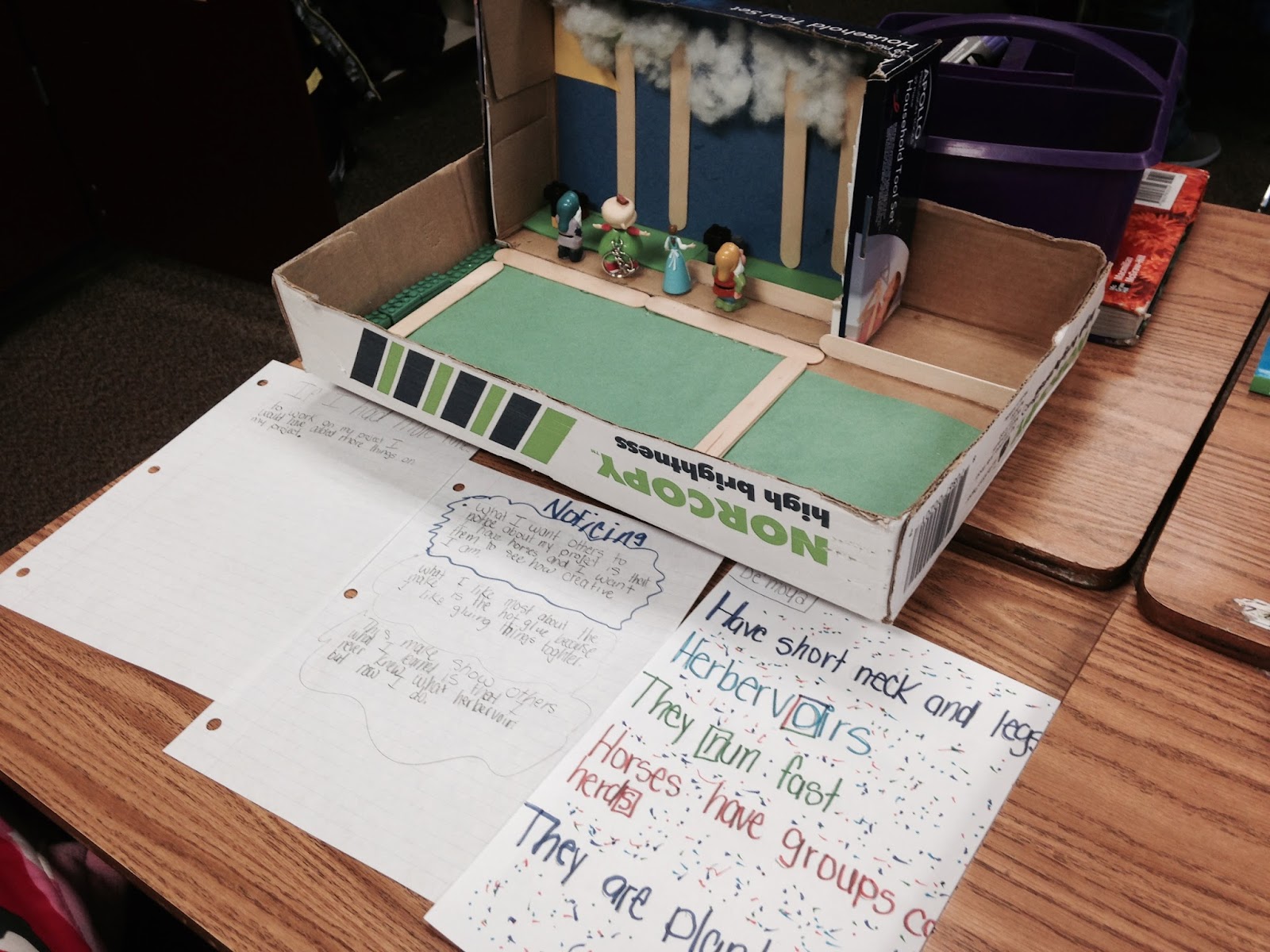
In an effort to help all of the students see the value in what they had learned through their tinkering with the toys "finished" or “not,” we asked them to look at what they had “completed” and reflect (in writing) on what they would do if they had more time. The reflection, like the two other pieces of writing, gave the students the opportunity to look back at all of the amazing work they DID complete; understanding that with any project, there comes a point when it needs to be abandoned, making room for the next learning experience. We asked the students to think of this reflection in this way so that when people came into the class and or to their desk to view their work, they had a “complete” vision of what they were looking at.
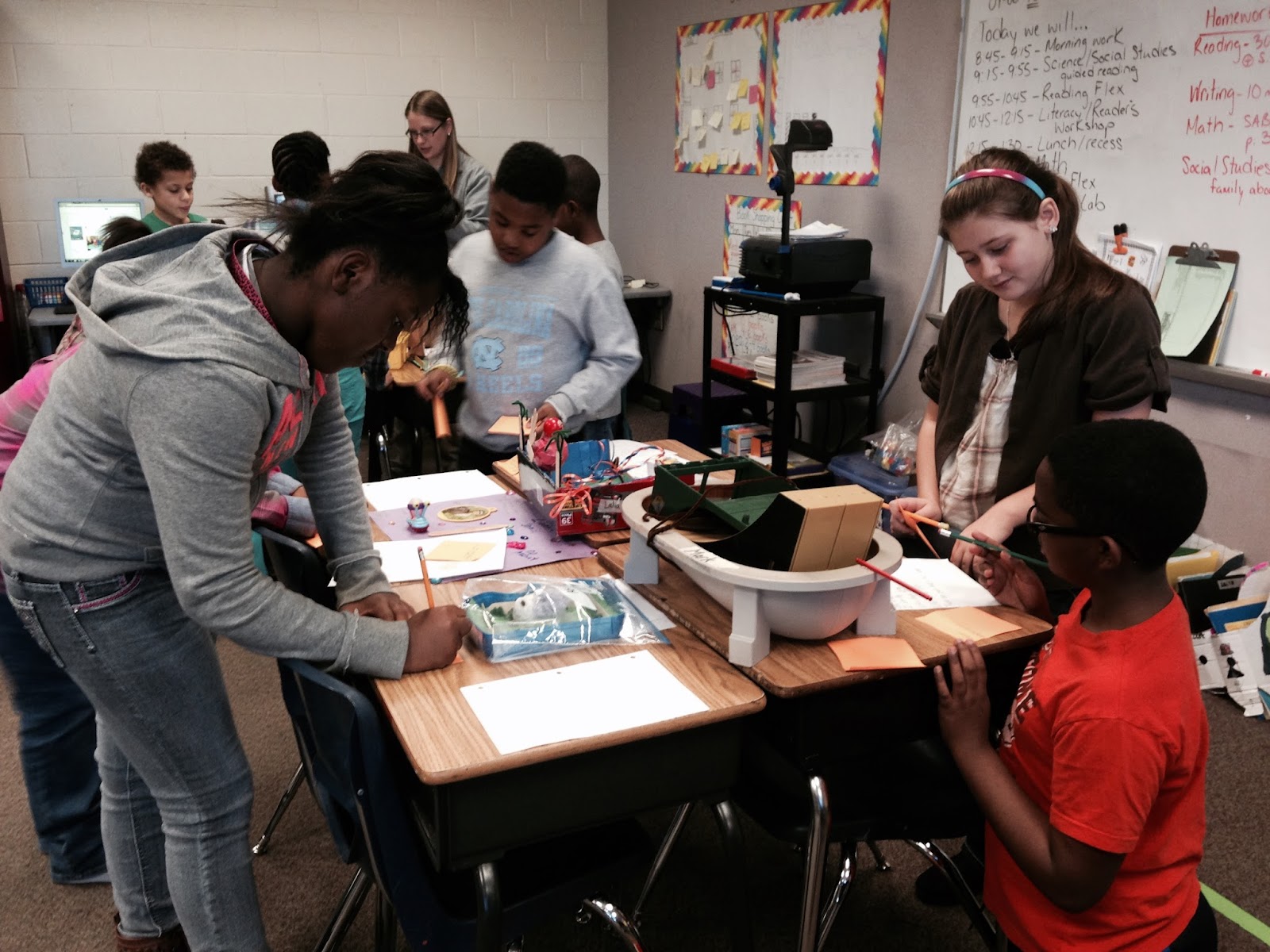
The gallery crawl was scheduled for one, 90 minute session so we could explain to the students what was expected and give them a decent amount of time to view and respond to each other's work. Students rotated around the room in groups of 4, viewing all of the amazing work that they made. Armed with sticky-notes and pencils, they commented and questioned what they saw and read. When the gallery crawl was finished, each student returned to their seat and read through the comments/questions that others had left for them. We then asked if anyone would be willing to share with the group what others had written to them. Even though the kids had the option to leave anonymous remarks many of them signed their names and each student that shared a sticky note from a classmate made sure we knew who the comment/question was coming from. They were so proud of themselves and delighted with what their classmates had to say to them about their work! The whole group sharing that followed the gallery crawl was very emotional in that the students were bonding with each over a project that included so much; reading, writing, thinking, sharing, collaborating, MAKING. It was overwhelming in a very positive way!
Saturday, January 31, 2015
Clinkity, clink, clink: Extended Inquiry into Marble Mazes
Last year I came to school one day to see a giant marble maze created with blocks by two older boys. It made the most pleasant sound as the marble got to the bottom: clinkity, clink, clink! There are these kinds of pivotal learning moments that stick in the minds of the kids even this year. The other day I heard a younger student, who started this fall and hasn’t met the older kiddos very often, referencing “the day Tino made the awesome marble maze.”

Marble mazes have become part of the culture the group of 2 to 8 year olds in our play based early childhood program. This year one of the oldest kiddo in our crew (age 7) began making marble mazes early in the school year. With lots of time trying this out at the block center another kiddo latched into this idea quickly. For at least two months there were marble mazes built every day. They were built inside with unit blocks, with miniature unit blocks inside and and outside and outside with hollow blocks.

Following this interest Carla, our Discovery Place partner, and I brought in more materials that might extend the interest. We made marble paintings, tried a pre-made marble maze kit, made our own felt balls and used cardboard and straws to create labyrinth style marble mazes.

It's been exciting to see all that has happened just around this one concept. It really has become a collaborative extended inquiry. Here are some of the things I noticed along the way!

Lots of physics is involved in block play and building generally. As kids manipulated blocks, cardboard or pre-made pieces they had to think about how the materials worked together, what would create sturdy pathways and walls. They decided which kinds of blocks or other materials would work for specific purposes. As they played more and more with the marbles, they developed understandings of force, movement, and incline. They tried different kinds of balls, too: felt balls, beads and wooden balls. They had discussions about the weight of the balls, the size and the smoothness of the surfaces and how this changed the way the mazes worked. They explored symmetry as they created two sides of the maze or two tracks side by side. They explored length and measurement as they tried to see and describe to others how far certain inclines would allow balls to roll and as they found ways to articulate to each other how long a certain part of the maze or even a certain block needed to be (i.e. "Hand me the long one. No, the one that is like two of these.")

And there were overarching learning ideas in constant play, too, particularly this inquiry made space for iteration, revision and mentoring from one another. They revised the mazes in the moment as they went. Usually a child would begin building and at some point would stop to try rolling the marble to see how things were going. Then back to building to make changes. Eventually they would declare the maze as ready or done and often get someone to come over to see how the marble rolled. Sometimes this sharing process would lead to more changes. Sometimes something unexpected happened during the share and kids went back to the drawing board. Sometimes another child coming to see would have an idea for improvement or just something different and they would try this out together. Very often multiple kids worked in the area on various mazes. They watch what others are doing and try the ideas out themselves.

They also hold the old mazes they have seen in memory and try them again next time. I guess this is the thing about the extended inquiry. This interest continued over months. So the kids were iterating all the time, trying the ideas again and agin. They were able to build on their own attemps, on what they saw other kids do and even on the lore of last year :) Overtime I saw marble mazes change from a long flat structure to ones with multiple pathways, two side by side tracks, high rise mazes, large scale mazes, mazes with obstacles. Something like adding obstacles spread through the group, until this idea was common knowledge.

Ideas from the marble maze inquiry spread wings in new spin off projects, too. The kids started making obstacle courses with large hollow blocks, chairs and boxes. Carla and the kids even made a rat maze for the Discovery Place rat, Patsy (now renamed by the kids as “Petsy”). They used blocks to build a maze with multiple paths and areas for Patsy to find carrots.


The social goes hand in hand with all of this (of course!!!). I saw how marble mazes worked to build relationships between children and among the whole group. As the marble maze inquiry continued and was shared, every child was involved at some point and so the inquiry became a point of cultural connection that was important in our transformation into a gelled community from opening of school into the fall. The reason the interest became an extended inquiry is because the kids felt connected to the ideas and the other people playing around with it. It's always back to the social-emotional :)

Sunday, January 26, 2014
Tired and inspired: lessons from three days of student making
I spent one week making with my students in October for our second make cycle. At the end of every day, I tried to do a little written reflection on the experience. Towards the middle of the week, I came to some important realizations that I captured in this reflection. The following post is one I adapted from the reflection I wrote after the third day of making with my students.
I was going to post on day two, but to be honest, I just didn't have the writing in me at days end. I don't think that I have it in my today either, but the inspiration I’m feeling from the events of today is driving this post on. Something special happened...something that wasn’t there on the first or second day...or at least not to the same extent. There was widespread flow...that space where the subject and the object had come together and it becomes difficult to tell where the artist ends and where his or her art begins. The kids were into it….the completely-lose-track-of-time-and-space sort of into it, and what they were making was no longer a set of boxes and pipe cleaners, papers and paint. Kids had direction and purpose. There was still tinkering, yes, but there existed a sense of ownership that before today was only apparent in limited amounts. Today was awesome.
I was talking with other teachers before today...talking about the concern I had that the requirements that I had set forth for the project...about it being connected to students histories, future career interest, and science...were sort of falling to the wayside. Kids were making cool stuff, but it really didn’t seem like what they were doing was considering these elements. And their makes sure as hell didn’t look like they fit anywayshapeorform into our broader Cycle theme of mapping.
But this disconnect seemed to shift today. Once students had an idea of exactly what there make was to be, they seemed to move forward with it with a greater consideration on these requirements that I had given them. This observation is important for the making classroom and teacher. This idea of “backwards planning” (or in our case backwards making), or making with the end object in mind, is closely tied to the common approach to teaching. There is an objective, a lesson gets designed around teaching that objective, and in the end students are measured on how well they mastered that objective that was clearly understood by all involved beforehand. Yes, I do see some faults in the model (because learning is a complex thing based on more variables than can possibly be considered, and regardless how clear the objective is or how well the instructor designs the lesson, no two students are going to see something exactly the same...let alone the objective as the instructor sees it), but still, I’d be lying to say that I didn’t adhere to it a little….the fact that I was frustrated and confused when I saw that the requirements weren’t shaping students' make is a testament to my holding this belief.
This school model, though, runs counter to the making (and learning) process. The learner does have some vision, yes, but as the composition as formed that vision is revised and revised based on the makers' experiences, struggles, and new learning.
So, coming back to this topic of requirements. I don’t think that they were a bad thing. I’m just seeing now that students’ not adhering closely to them in the first days of the project was perfectly fine. I didn’t beat the requirements into them when I noticed they weren’t being considered...and I’m seeing now that was a good thing. Requirement beating wasn’t necessary. Space, encouragement, and freedom to make was. Before students fully understood exactly what it is that they were making, they weren’t yet ready to consider the requirements. Now, with direction in place, I’m seeing all sorts of deep thinking happening on the parts of students about just how those requirements (and even how the idea of mapping) applies to their make, and this thinking is shaping the final vision...or revision, about what they are composing.
So my take away….requirements are OK, so long as they do not become restrictions. It’s fine to plant the requirement seed in the beginning, but give it space for it to grow. It’s not possible for students to develop a close connection and vision of their make if they are making it to meet a focused objective. Let the connection happen and the make become personal. Forget the vision of what it should, or even could, look like. Let them discover it for themselves and then figure out how the requirements should apply.
And oh, here are a few other things that I noticed.
- space for collaboration is valuable...because of it, students draw on each other for their skills, experience, and expertise. Partnership form between individual makes already started, forming new, more complex integration of ideas.
- Painting...it’s messy, but seeing it in the hands of students makes me even more sad that art was cut. It allows for more than just a creative outlet, it brings about really deep and complicated thinking...like Maria’s Pink Floyd-album looking painting that speaks to the disconnect between humans and machines when it comes to her knowledge of the medical field...or Sebaistians' black box that connects his knowledge of minecraft to his future in computer engineering.
- Time. An hour a day for five days is hardly enough. I worried about this before we started, but I was thinking we’d have too much. Nope, not at all.
- Cardboard is the ultimate making material.

A time and a place to think...

This weekend was spent making, planning, hacking, and collaborating with a special group of people. I can't wait for our "teaser" trip to Discovery Place!
Saturday, January 25, 2014
Making STEAM and ME...
Saturday night...the end of a long day of planning...collegiality and...making! I'm hanging out at Ocean Creek Resort in North Myrtle Beach, on a retreat...with a cohort of people from the UNCC Writing Project, Tar River Writing Project and Discovery Place. We gathered here this weekend to think more about a project we are currently engaged in called the Intersections Project. The only way something as ambitious as the Intersections Project "works" is if all the key stakeholders involved get the opportunity to imagine what that project may end up looking like...as they are making it.
That's exactly what this weekend retreat has been all about...a chance to imagine what is possible. Getting to spend time with Michael (our Discovery Place expert) and Mary Catherine (my friend and fellow teacher at David Cox Road Elementary School)...thinking about our 2nd Make Cycle and planning out future experiences at Discovery Place has been very exciting. How so you may be asking?
Well...to begin with...through our collaborative efforts...we are attempting to plan an experience that will be memorable for the students we teach while showcasing...to our principal...an image of learning not currently valued in many traditional school settings. Memorable in that "it" (a series of field trips to Discovery Place and the McColl Museum) will connect what students are learning in the classroom with the concept of MAKING as well as the connections (or intersections) between Science and Literacy they will inquire into while on their field trip. The image of learning we hope to illustrate as having value is one that involves risk...creativity...imagination...collaboration...and...the realization that much can be learned through failure.
Just this week...Michael, Mary Catherine and I witnessed...in our respective classrooms...what learning could be like as the students built structures with rectangular, wooden blocks. After spending a few minutes examining the blocks' attributes and engaging in free building...to figure out what could be done with these ordinary pieces of wood, the students attempted to build structures that could hold a predetermined amount of weight while trying also to see how high they could build something. No one laughed when somebody's structure fell...instead words of encouragement were given...along with advice...based on what was being learned through the experience.
Why can't this level of engagement happen during a traditional lesson on (for example) understanding how to determine cause and effect in non-fiction text? What is missing in our practice that makes the wooden block experience stand out as something foreign to what happens daily in our classrooms? Working with Michael and Mary Catherine...through the Intersections Project...provides me space to think about these and other questions.
Thursday, October 17, 2013
Launching a Collaborative Project through "Yes, And"
The elevator door opens and I fumble my overfilled rolling cart of magazines, tape, wires, batteries, paints and cameras onto the second floor. About ten of my friends and colleagues and a few new faces are moving in some kind of purposeful chaos around the lobby. Sally, a high school English teacher, walks up to me her hands out stretched holding an imaginary box.
"Lacy! Thank you for this old banana peel!"
Having played this game before I get the cue and reply with only the smallest stutter, "Oh, yes! And I just knew how you needed this for your compost bin."
 Sally and the other folk playing around in the lobby are Discovery Place educators and National Writing Project teachers and their colleagues coming together for the launch of our collaborative project: Making STEAM: Discovery Place and UNC Charlotte Writing Project Intersections Project. Through a grant from the National Science Foundation we have come together to create a partnership for exploring and enacting intersections between science and literacy.
We began our day with the improvisational work in the lobby to both build community and to embody some of the big ideas in our project. Our Writing Project site and Discovery Place have been playing with improv in our classrooms, learning spaces and professional development experiences to understand connections between the body and language. As we play with, perform and show how language works through our bodies we begin to grapple with an idea Michael Polanyi, a chemist and philosopher says this way: “it is not words that mean, but I who mean by them.”

The "yes, and" game in the opening story connects to our work in several ways. The maker movement embraces "yes, and"ing of materials and concepts through recreating, remixing and meshing technologies and tangible materials. (Yes, this toy car that buzzes, honks and plays five tunes, doesn't leave much to the imagination. And there are motors inside this toy that we can take apart and use to make a scribblebot using our own designs!)
 We also are using "yes, and" to learn from one another as educators, who inhabit differing contexts. We can "yes, and" to figure out how sharing from multiple work positions can make the familiar in our worlds strange and lead us to different images of possibility (i.e. What if a school classroom space worked sometimes more like an interactive science museum- where the materials and environment encouraged informal learning? And what if field trip and science museum experience planning working sometimes more like the National Writing Project network- where people are the biggest resource, and fluid collaborations are reflective and fluid?)
Our big undertaking in this project is to "yes, and" the public school context of teachers in the project, whose context is rich with a history of public discourse, social justice and critical pedagogy and rife with the constraints of the corporate, high-stakes test-taking agenda. We are imagining ways of leveraging this context as we mesh intentionally with the pedagogy of informal learning and community centeredness of science museums and the humanizing and empowering connection of the National Writing Project.
 Read more on the About page and stay tuned for our future posts to find out more about the story of our collaboration as we harness our experiences with STEAM (science, technology, engineering, arts and math) based learning and the maker movement to think together in the intersecting spaces between science and literacy with the intention of "yes, and"ing learning spaces in and out of school.
Lacy Manship,
Teacher Consultant & Associate Director
UNC Charlotte Writing Project
"Lacy! Thank you for this old banana peel!"
Having played this game before I get the cue and reply with only the smallest stutter, "Oh, yes! And I just knew how you needed this for your compost bin."

We began our day with the improvisational work in the lobby to both build community and to embody some of the big ideas in our project. Our Writing Project site and Discovery Place have been playing with improv in our classrooms, learning spaces and professional development experiences to understand connections between the body and language. As we play with, perform and show how language works through our bodies we begin to grapple with an idea Michael Polanyi, a chemist and philosopher says this way: “it is not words that mean, but I who mean by them.”

The "yes, and" game in the opening story connects to our work in several ways. The maker movement embraces "yes, and"ing of materials and concepts through recreating, remixing and meshing technologies and tangible materials. (Yes, this toy car that buzzes, honks and plays five tunes, doesn't leave much to the imagination. And there are motors inside this toy that we can take apart and use to make a scribblebot using our own designs!)
 We also are using "yes, and" to learn from one another as educators, who inhabit differing contexts. We can "yes, and" to figure out how sharing from multiple work positions can make the familiar in our worlds strange and lead us to different images of possibility (i.e. What if a school classroom space worked sometimes more like an interactive science museum- where the materials and environment encouraged informal learning? And what if field trip and science museum experience planning working sometimes more like the National Writing Project network- where people are the biggest resource, and fluid collaborations are reflective and fluid?)
Our big undertaking in this project is to "yes, and" the public school context of teachers in the project, whose context is rich with a history of public discourse, social justice and critical pedagogy and rife with the constraints of the corporate, high-stakes test-taking agenda. We are imagining ways of leveraging this context as we mesh intentionally with the pedagogy of informal learning and community centeredness of science museums and the humanizing and empowering connection of the National Writing Project.
 Read more on the About page and stay tuned for our future posts to find out more about the story of our collaboration as we harness our experiences with STEAM (science, technology, engineering, arts and math) based learning and the maker movement to think together in the intersecting spaces between science and literacy with the intention of "yes, and"ing learning spaces in and out of school.
Lacy Manship,
Teacher Consultant & Associate Director
UNC Charlotte Writing Project
Subscribe to:
Posts (Atom)