Tuesday, February 14, 2017

Making ELA Through The Community Project

-written by Mary Kendrick

My interest in “make” was sparked by a week-long “Making” Teacher Research Institute hosted by the UNC-Charlotte Writing Project. During this week, a group of teacher-consultants came together to explore questions such as “What is a ‘make’?” and “What does the maker movement have to do with writing and teaching?”.  Most of our learning was experiential. We wrote six-word memoirs on quilt squares, played with paper circuitry, made stop-motion videos with Legos and Playdough, and tinkered with web-based tools to create cartoons, movies, memes and avatars. I found “make” intensely engaging--it was hands-on, playful, invited exploration and experimentation, and made me take creative risks outside my comfort zone.  So, when teachers at my school were invited to participate in the Educator Innovator project “Making our Worlds”, I was excited to bring “make” into our ELA classrooms.


While “making” is more commonly associated with STEM courses, ELA and “make” are also a natural pairing; the “making” process has much in common with the writing process, and ELA teachers are no strangers to hands-on, creative projects. That being said, when looking for ways to integrate “make” into lessons, we wanted to be sure that our activities were true “makes”. ELA projects are often highly-structured and teacher-directed, with detailed lists of requirements, step-by-step instructions, and prescriptive rubrics describing what a “successful” outcome looks like. A true making experience is open-ended, has no pre-defined outcomes, offers participants a variety of mediums and materials to choose from, is interest-driven, and includes little to no instructions about how to do anything -- we wanted to incorporate as much of the “making” ethos as possible, while also using “make” in purposeful ways that accomplished ELA curricular objectives.


We achieved this goal in 8th grade ELA when students participated in the Community Project Make. Our school is an International Baccalaureate Middle Years Program (MYP); the culminating MYP experience is the 8th grade Community Project, which our 8th graders complete in ELA. In this project, students investigate a community issue and take action on that issue. The Community Project Make happened at a crucial stage in the project--students had identified their topics and done some research, but hadn’t planned how they’d take action. We used the community project as way to help them crystallize their thinking on the issue and play with what it meant to take action.


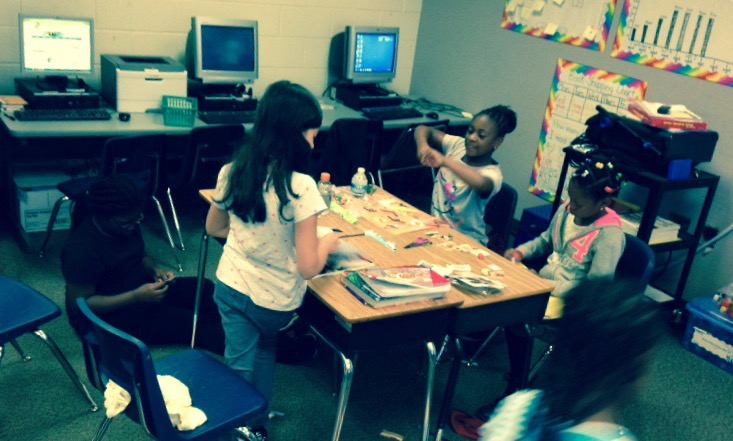
On our make day, we set up four make stations in the room -- 3D poetry, black-out poetry, card-board badges, and stop-motion animation. Before students began making, we asked them to reflect for a few minutes on what they’d learned so far and what they were thinking and feeling about their community issue. We then set them to a very simple task: Make something that sends a message about your topic. After a quick overview of the make stations, we let them loose in the makerspace to begin experimenting with how they could use the materials at hand to communicate their opinions. Students eagerly dug into the materials, creating makes that expressed their stances on issues such as cutting, homelessness, literacy, and healthy living: a bleeding and bandaged hand with the message “Scars Will Last”, a pop-up poem that began with the line “Keeping your money just to yourself does not make you powerful”, a cardboard and tape badge supporting youth sports declaring “Let us Play!”, and a stop-motion video depicting how books bring happiness.


As students’ worked, I was heartened to see them enlivened by making in much the same way that I had been. They were focused and engaged as they worked, collaborating easily and naturally with each other. They were happy to experiment and test out ideas and didn’t hesitate to revise and remake when first attempts didn’t work out. Students who often struggled to stay focused on reading and writing tasks were completely on-task in an environment that was hands-on and allowed for movement and conversation. English language learners and special education students thrived as well. Several novice English speakers chose to use Spanish in their makes, while a special education student who struggled to express herself in writing was able to communicate her thoughts on girls’ distorted body images with a 3D cardboard sculpture.  Of course, there were a few students who found the experience challenging: they couldn’t settle on any particular make, and left half-finished makes all around the room, tinkering uncertainly with the materials at hand. Some high achievers, accustomed to easy perfection with traditional academic tasks, experienced frustration when asked to do something with no clear directions or set parameters. Yet, even these students were able to leave feeling they’d accomplished something because the Community Project Make wasn’t focused exclusively on the product--engaging in the process and taking risks  were just as important, and even the students who struggled and been open to trying and left the room with a make in hand.


The Community Project Make was also a productive learning experience that effectively moved students into the next stage of their projects--writing a plan and putting that plan into action. Creating makes that sent a message helped students focus on the things that mattered the most to them, which in turn helped them develop the goals of their projects and decide how they would make a difference.  

In reflecting on the Community Project Make for this piece, I realized that what made the make especially useful, was that it wasn’t an add-on--it was an integral part of the students’ process. It helped them think through where they stood on their topics and took the place of more traditional ELA activities that we could’ve assigned students, such as creating an outline or completing an idea web. This ELA make let students experience true agency as the made choices, accessed their own voices, and expressed truly personal interpretations through their work.

Saturday, October 15, 2016

Me with me--Making STEAM Episodes

In this series of hangouts, educators participating in the Intersections project met digitally to engage in a make-experience together. Each video consists of a brief overview of the make, and then time spent making and talking, as educators discuss what they learn through the process and how such a project might play out in their classroom.

Making STEAM Episode 1: Interdisciplinary Learning through Cardboard Cities

Making STEAM Episode 2: Boundaries in STEAM with Stopmotion Video


Making STEAM Episode 3: The Science of Translation through a Textile Make


Make with me--Making STEAM Episode series

In this series of hangouts, educators participating in the Intersections project met digitally to engage in a make-experience together. Each video consists of a brief overview of the make, and then time spent making and talking, as educators discuss what they learn through the process and how such a project might play out in their classroom.

Making STEAM Episode 1: Interdisciplinary Learning through Cardboard Cities

Making STEAM Episode 2: Boundaries in STEAM with Stopmotion Video


Making STEAM Episode 3: The Science of Translation through a Textile Make


Supporting student dialogue in our online community of makers

The Intersections Charlotte project brought together students and teachers from different area schools with Educators from Discovery Place to engage in student-driven make-based work at  each
of the respective sites. The Making STEAM Google+ community was born out of the necessity to to keep all parties connected through the entire process. It was a place for students to post not just their finished makes, but also work in progress, reflections, and responses to the ideas of others. It was a place for sharing, for conversation, and for inspiration.

While students were familiar with operating in social networks in their own lives, there was a bit of a learning curve (for both students and teachers) in discovering how to make this site work in a way that both invited students ownership and and rich feedback on student work. Hitting the +1 button or leaving a comment like “good job” doesn’t give the maker much insight into how his or her production worked in the mind of of the person who was viewing it. This sort of feedback required students to have some specific ways of responding that were open-ended, promoted a conversation, and developed scientific habits of mind that are cultivated through conversation and iteration.

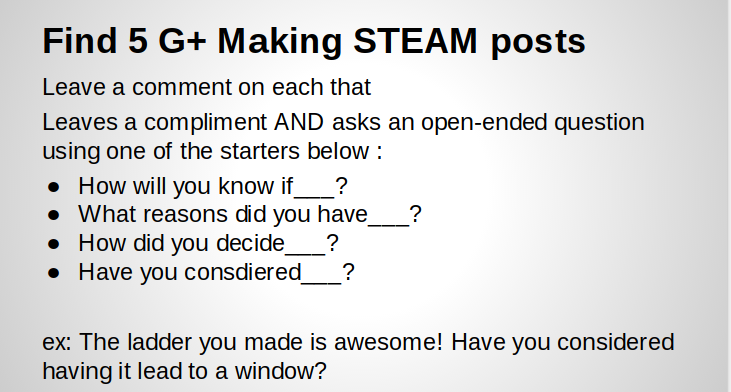
As much as making isn’t a fill-in-the blank sort of venture, having some frames for students to refer back to when responding helped to get them feeling what it was like to see their comments as an important part of a conversation.

Here is a slide Steve used in his class during time set aside for reading and responding to the work in the community:

Below is a a post made by Levar showing a stop motion video he created inspired by the Hunger Games, but taking place in a setting he made from cardboard character that were repurposed army figurines:

Screenshot 2016-10-15 at 3.58.55 PM.png

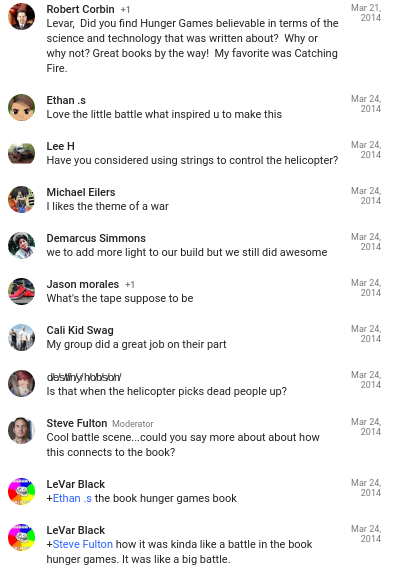
The post elicited 19 comments where viewers and LeVar exchanged ideas. Here is a piece of that conversation:
Screenshot 2016-10-15 at 3.57.40 PM.png

In this conversation that includes students, LeVar’s teacher Steve, and Robert from Discovery place, the feedback posed prompted LeVar to clarify and even provided ideas for future interactions. It all worked to bring in other people as thinking partners and keep LeVar moving forward in his own process.

Making across content, composing cardboard cities

Cardboard is the ultimate make material. It’s cheap (or FREE...there’s usually plenty of it piled by the recycling bin behind any school), sturdy, and relatively easy to work with if you have a good cutting tool and some tape or glue. This post tells how a language arts and science teacher collaborated to create a make-based learning experience inspired by content in both of their classes and built with…..cardboard!


For this make, students drew upon the setting and novels they were reading in language arts and their learning about sustainability in science class to construct cardboard cities.  For language arts, students participating in books clubs, where students read in small groups a novel with a group of their classmates and regularly completed literacy-related mini-lessons and group discussions.  The novels, 20 or so in all, spanned in genre from biography to dystopian fiction, but fit thematically into the unit being taught, which focused on responding to injustice.  


In science, Tiffany was teaching an earth science unit on natural resources, with content and discussions focused on constructing a conceptual understanding of sustainability in the world today. The setting and events of the novels would serve as starting places for the cites’ construction, and the decisions students made while constructing them would be made through the lense of sustainability.  

City planning and hacking the school day
Students in one of Steve’s classes (perhaps considering what they had learned about sustainability with Tiffany) raised the concern that there would not be enough space for 20 cardboard cities to be built and suggested that groups build collaboratively. With a bit more discussion and negotiation, both the teachers and students settled on the idea that groups would add to one of four cities depending on the time period their novel took place, thus giving rise to the Historic City, Modern Urban City, Modern Suburban City, and Future City.  

In planning how to organize this make, Steve and Tiffany (as well as their students) felt like one hour a day was nowhere near enough to really dig into a make, and Steve and Tiffany wanted the make to be inspired by more than just a single entry point from their class content; rather, they hoped to see what students made and the content of their classes serve complementary purposes that deepened over a period of time. The solution they decided on was a make that took place over the course of five weeks, with one day per week being devoted to making.  On this day, during the time that students had ELA and Science, they would go to the room where their city in progress was located. Two were in Tiffany’s room, and two were in Steve’s.

Supporting the making and iterative process

Sometimes students would continue right where the left off, but other times students would consider the new events that they had encountered in their novels or new concepts that had been introduced in science during the week since they had last worked on the structure and use this knowledge to revise what they had been working on.  It wasn’t just the new content students had to consider, though. Steve and Tiffany introduced new materials and possibilities into the makerspace each week. The foundational materials students needed to construct (cardboard, scissors, glue) were always on hand, but over the course of the make students also were invited to paint, add working circuits to light LEDs, and also to use their cities as settings for stop motion videos.


Read more about the project and what students thought about it in the article from a local newspaper below:

Photo:

Thursday, June 23, 2016

Integrating "Make" into the Curriculum; Navigating and Altering the Linguistic Net - By Tony Iannone


My first “real” attempt to bring the concept of “make” into my 4th grade classroom came as a result of my involvement in the Intersections Project. In collaboration with my Discovery Place thinking partners I devised a culminating project my students would engage in as they finished a Science unit on Nutrition. Prior to my involvement in this project I questioned whether or not the informal, authentic process of “thinking like science expert” that my Discovery Place partners brought to our collaboration would mesh with the more formalized manner that science is taught in schools. It is easy to understand why pressure coming from things like curriculum guides could complicate the manner in which “makes” find their way into public school classrooms. The language of a curriculum guide includes standards, objectives, and descriptions of activities; literally spelling out what is supposed to be done relevant to the content it was created for. Over time, this language can place a sort of linguistic net over the rich experiences of students during MAKE cycles. This net (a systemic construct that is neither malicious nor benevolent) through language, ends up determining what is a learning experience, how students grow, and finally what learning looks like at any given moment in our classrooms so as to report out to the world the kind of learning that is taking place. This resource seeks to construct something different, an image of possibility for educators, leaning on what might, at first glance, seem familiar (how a teacher could navigate her way through an upper elementary Nutrition unit), when it comes to considering the ways in which “make” finds its way into our classrooms. As we move forward, cultivating our own images of what is possible, reflecting about them with our students and each other, we can begin to speak back, maybe even re-define the systemic construct mentioned above.

The Nutrition Make

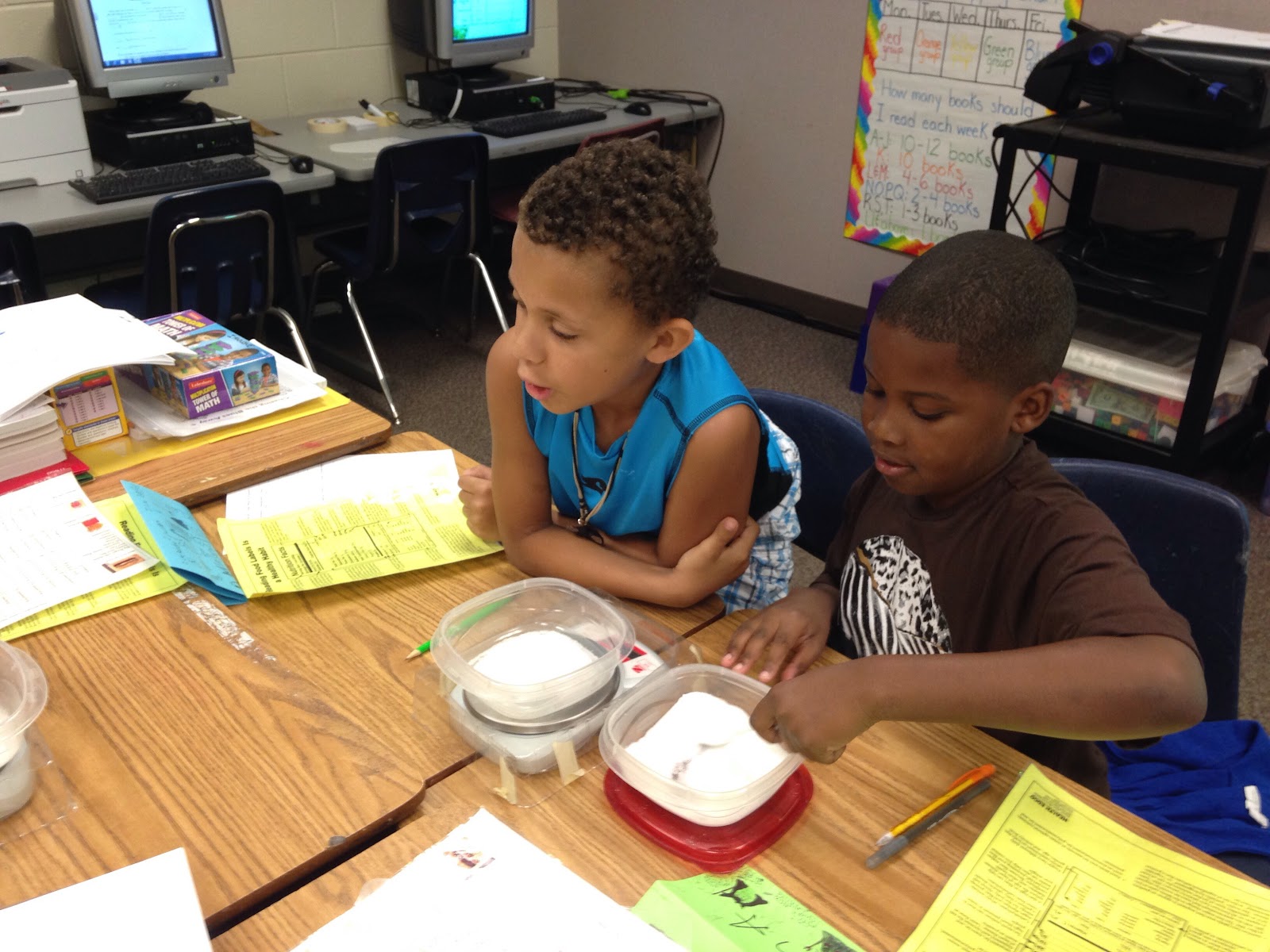
Prior to the project the students participated in several experiences, some traditional, some quite unique given the formal setting of the classroom. The traditional experiences included reading information related to nutrition in their Science textbooks and taking notes about the readings. One unique experience involved getting the students to learn about how much fat and sugar is in a typical fast food meal; thanks to a really exciting, interactive lesson my Discovery Place thinking partners led with the class. The informal (social) nature of this experience; hypothesizing, measuring, recording, thinking, discussing, and reporting out seemed very far away from the more formal (isolated) approaches where students would read and answer questions about that reading. To say this experience was met with high levels of joy and enthusiasm from my students is a mere understatement!


We had the students reflect, in their notebooks, about what they were learning and how change (defined in this case as the choices one makes regarding his/her dietary choices) can be positive or negative.


Choosing to layer the theme of change over the standards and objectives for the Nutrition unit was a decision we made prior to the beginning of the school year while planning with together. We were looking for a way to bring some critical thinking and complexity into an otherwise standard science unit. We wanted the students to be able to "bridge" what they were learning in science and literacy in a somewhat sophisticated fashion. Interdisciplinary thematic instruction includes taking large scale themes, like change, and generalizations like "Change can be positive or negative;" layering both over the curriculum so that students can use the content, (the Nutrition unit in this case)  to prove or disprove the generalization while learning something new about the theme. As the Nutrition unit came to a close we wanted the students to engage in a “make” that would enable them to “mine” the experiences, reflections, and ideas related to change they had engaged in. Why might you ask was this “make” integral to the overall experience?

Why it Matters!

One of the tenants of “make” is that it, “invites students to make things with words, with natural and manmade materials, and with their ideas of how to make their worlds.”  We proposed the following to the students; create a collage, using images and text from magazines, art supplies (pipe-cleaners, glitter, ribbon, stickers, construction paper, markers, colored pencils, etc.) to “make” a representation of concepts learned throughout the unit. The collage also had to show evidence of the generalization “Change can be positive or negative.” By participating in this “make” students were in essence re-presenting their understanding of a concept (nutrition) that had been presented to them throughout the unit; they were “making” new and unique images of what nutrition meant to them. Being asked to re-present your understanding is different than being asked to re-produce what has been presented to you. Re-presenting implies you are capable of being creative both textually (with language) and concretely (with materials) you have at your disposal. Re-presenting implies that from this creativity, you have something important to say. Re-presenting implies that what you have to say should be shared, with others as you engage in “making your world.”


Another important tenant regarding the concept of  “make” played itself out during this culminating project. Make, “use[s] content specific to a grade levels' course of study and [is] literacy rich, asking students and teachers to share, reflect, loop back, remake, revise, remix, and connect with others.” The content specific to my students’ grade level was nutrition. The content was literacy rich in that I pulled material from the students’ textbooks, trade-books, as well as online materials. Throughout the project we shared ideas with each other as the students planned what to include in their collages. Typically there is not space for sharing, reflecting, looping back, remaking, revising, remixing and connecting within the confines of formal learning. Skype chats, Google Hangouts, real-time, in person meetings with both my thinking partners from Discovery Place and my National Writing Project colleagues helped me facilitate this informal, authentic, and crucial component to the culminating project.

Typically, due to the linguistic, systemic net that is cast over teaching and learning, teachers are supposed to present content, students are supposed to receive it, then reproduce it in the form of some kind of standardized, formative assessment meant to measure what was received. Working against from within this “net,” the students looped back to the literature/content (they received) as well as the notes they had taken, not to reproduce what they received, but to put their collages together in an attempt to ensure that what they were “making” was a re-presentation of what they had learned.

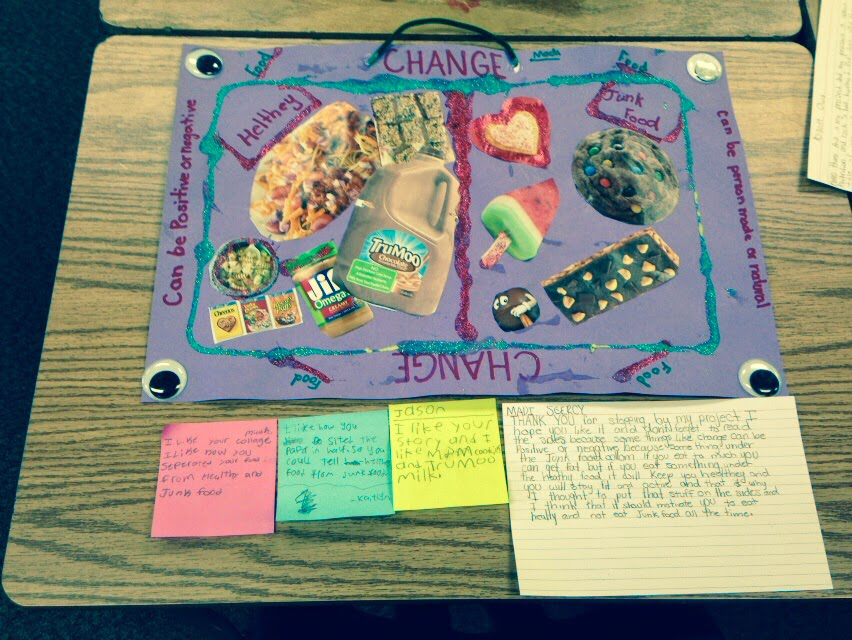
Here is an example of student’s MAKE...a re-presentation of what was learned...


This student’s collage focuses on what she learned during the Nutrition unit. She has arranged what she has learned about food into 2 categories, foods that are healthy and “junk food.” What sets this MAKE apart from others is an integration of the theme and generalizations explored over the course of the unit. This is evidenced strategically around the outside of her collage. Most notably, the student placed the theme at the top and bottom of the collage. The generalizations; “Change can be positive or negative” and “Change can be person-made or natural can be found on the left and right of the collage. A closer look at her writing (see  the index cards) reveals that these thoughts about change are not just placed there “for show.” She encourages her viewer to think about her placement of the words and phrases and why thinking about food this way “should motivate you to eat healthy” and “not eat junk food all the time.” Her classmates acknowledge the intent of her work (as evidenced through the 3 sticky notes) showing that her message resonates with them. The results of my student’s efforts may not necessarily be measured via standardized testing...but (as witnessed in the example) are equally important in order for children to re-imagine what is possible from their position as student learners engaged in JOYFUL learning experiences!


Wednesday, June 22, 2016

Eighteenth Century Theme Parks - By Sally Griffin

The students in my high school senior English class have pretty much sunk into the routine of high school: write the paper get the grade, do the homework and get the grade, take the test and get the grade.  They don't necessarily look for anything exciting; but are surprised when it occurs.  My students were particularly surprised and delighted when they were asked to discuss the damage the trash that we accumulate could be doing to our earth and then were asked to describe some things we could do to change that.  That is how our "maker faires" in our classroom began.

One of the most difficult units for my students to grasp is the literature of the eighteenth century.  The reading is tedious for them and they often just don't do it. But the eighteenth century is full of inventions (the age of enlightenment), new writing genres, satire, and discovery of self.  It also marks a time when people came to see the human being as distinct from nature. Suddenly the earth was less important than what man could create even if it meant destruction of the earth.  This became a concern for the class as we moved through the fiction and nonfiction of the period.  My classroom was filling up with recyclables (in our own humble attempt to save the earth).  The students loved the idea of using up the recyclables to build theme parks that would reflect what they had learned about the eighteenth century.  Many of them were taking physics or biology and were anxious to incorporate ideas from those classes into their English class.  The first year we made theme parks, they were somewhat elaborate (depending on the particular group's understanding of the literature) but always creative.  The next year, I upped the ante by requiring that some or all of the park offerings move.  The physics students were ecstatic.  They found toy personal fans, stripped the motors, and attached them to Ferris wheels, petticoat rides, roller coasters, and other rides and attractions.  Some of the students used string lights to create different effects for different areas of their parks.  The mixture of ideas from the twenty-first century and the eighteenth century did not seem to bother them as they created rides of the future and gave them eighteenth-century qualities.


The theme park offers a way to assess student learning.  I always have thought that I needed to see what each student—independent of the others—is doing and knowing so that I can know what I need to do to help this student "get it."  I can see from what they build how they understand the assignments and what connections they are making.  That helps me structure future lessons.  Students went back to the pieces they had read, making sure they were correct and searching for innuendos that would make their park more interesting.  Each student contributed to a group paper describing the theme park for visitors and each student wrote her own paper about the experience.  Several wrote that they learned more about this unit than any other because they were left alone to do their own research and to choose what was important to them.  


In high school, students easily put what they are learning in each different class in a different box or notebook and leave it there---sometimes forever.  The maker movement in my classroom forced them to use what they were learning in other classes to complete the assignment.  Before the advent of testing and teacher paranoia over getting in the tested curriculum, students were free to let their minds roam from one class to another and teachers from different disciplines actually had conversations and incorporated each others' disciplines in their lessons.  These students had an opportunity to experience the interrelatedness of the disciplines through these makes.  They became responsible for their own learning and did more research and actual learning than they would have done without the hands-on experience.


The use of recyclables to create the projects took on its own life.  Suddenly students began to contemplate how they could remake something that had become obsolete into something useful.  They became more aware of what could be recycled and what went into the landfill.  They went to the physics/biology teacher for more information and for the life of items in the landfill.  The combination of creating out of unwanted items, reading environmental stories and accounts, discussions, and writing about it brought about change in our community—one that promises to continue as we continue to create new opportunities for learning through makes.Sall


Tuesday, June 21, 2016

Angry Birds Tinkering

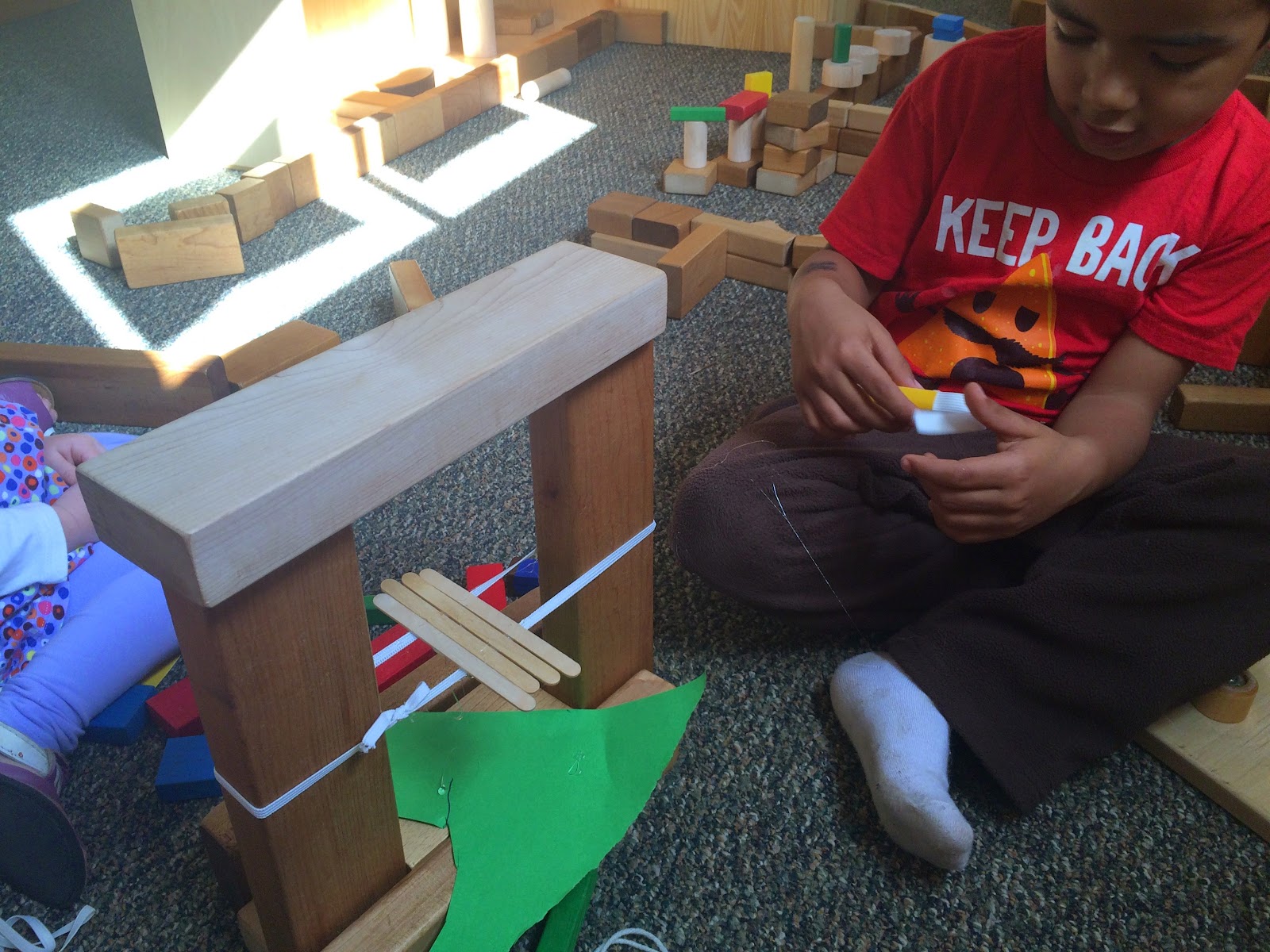
IMG_4194.JPGCatapult.JPGIn the late fall five year old Izaiah spent weeks re-creating and extending scenes from the game Angry Birds by building small block structures and knocking them down by tossing another small block at them.  Eventually he decided to construct a catapult to launch items into his structures.  On the day the photo here was captured he was particularly engaged in this task.  He had already spent some time playing around with the catapult idea and for about an hour on this day he used various materials and the support of a thinking partner and mentor (Lacy) to try to get the catapult to work in the way he wanted.  First he tried a zig- zag arrangement of yarn; then he hot glued the popsicle sticks as a platform.    He  backtracked and tried just one piece of yarn and added support blocks to keep the catapult stable.  As he worked he and Lacy talked about the materials he was using.  They talked about how the yarn seemed tight, but then would loosen and become slack.  Izaiah decided he needed something stretchy.  Lacy offered the idea of elastic and fished a piece out of the sewing basket for him.  This worked a bit better and the block did get some launch movement.  Another child came by and offered that Izaiah needed something like a rail to keep the block on the platform during launch.  So Izaiah and Lacy tried to attached pipe cleaners to get this effect.  With each small adjustment Izaiah tried launching a block.  Usually with little forward movement, but with a lot of joy in building a structure to knock down, making noises to launch the block and storytelling about what was happening with the pieces. Lacy and Izaiah got some okay launches in by the end, not perfect launches, before Izaiah decided to turn his attention elsewhere.  Later when Izaiah and Lacy looked back at the photos of the catapult he offered this poetic reflection:

An angry birds launcher
Angry Birds space
Put a block to destroy the castle
I wanted to play
Angry Birds Castle
If you pull it,
you need something
to hold on to it.


Monday, September 7, 2015

Formal and Informal Learning Can Coexist Within Varied School Worlds by: Tony Iannone

Formal and informal learning can coexist
within varied school worlds.


Imagine the following scene; an elementary school teacher and his Science thinking partners (from Discovery Place) have just placed an array of materials in the middle of his fourth grade classroom. The materials include (among other things) used and broken toys, construction paper, art supplies like construction paper, markers, crayons, duck tape glitter, pipe-cleaners, glue-sticks, glue guns, and tissue paper. The school teacher’s Science thinking partners add to the mix, bringing tools like screwdrivers, scissors, and hammers. The room is buzzing with excitement as the students anticipate how the materials assembled have anything to do with what’s supposed to be happening this morning. The teacher moves to the middle of the room, gets the students’ attention and states, “This has been an amazing year of discovery! We have learned a lot from each other. To honor our learning journey together Maggie, Michael, and I have compiled this assortment of materials you see in front of you. Your directions for the next 90 minutes are simple, get up and MAKE something.” Because of their previous experiences with the adults in the room, the students were up, out of their seats, eager to get started, before their teacher finished his last thought! What ensued was a 90 minute exploration into what was possible via thinking, collaborating, problem-solving; MAKING!


The scene depicted above is rooted deeply within a concept known as MAKE. By MAKE, I mean a process that involves (but is not limited to), inviting students to literally, make things; with words, with natural and man-made materials, and with their ideas of how to make their worlds. MAKE (within the context of school) uses content specific to a grade levels' course of study and is literacy rich, asking students and teachers to share, reflect, loop back, remake, revise, remix, and connect with others. How does a teacher, situated within a school world predicated on formal learning, partner up with Science educators from Discovery Place, an organization established on the premise that informal learning is what ignites wonder to create space for students to learn, and, through experiences like the one described above, balance both forms of learning? The short answer; through participation in collaborative happenings like the Intersections Project. Not enough detail? Want more? Keep reading. Understand though, before you proceed that the long answer is a bit more complicated, nuanced, and full of twists and turns. That should not stop any of you though because if you are reading this resource, you are, like me either a teacher or some variant of educator that spends the majority of your day working within this complicated, nuanced, “twisty-turny” world. It is very familiar terrain so, come and join me!


Formal and informal learning can coexist
within varied school worlds.


The path ending with the MAKE described above comes through hours of negotiation; negotiation with pacing and curriculum guides, with administrators curious and simultaneously supportive of how Science and Literacy intersect through the concept of MAKE, with the Science educators from Discovery Place in an effort to align both forms of learning, and finally with the students, who come to the classroom well versed through their many and varied experiences, in both forms of learning yet a bit tentative as to how both can intermingle within their classroom. Negotiations of this nature are not foreign to anyone reading this piece. Like me, you engage in similar forms of negotiation daily as you attempt to construct (dare I say; MAKE) a learning experience for your students that will result in your students getting the most out of the instructional day.


Formal and informal learning can coexist
within varied school worlds.


For me, the path has been paved through my participation with the Intersections Project. This project paired classroom teachers like me with Science educators from Discovery Place in an effort to inquire into the intersections of Science and Literacy, as well as formal and informal learning. My participation has taken many forms; both outside of the classroom, through planning sessions and within the classroom. A recent example of participation took place in my classroom while I was teaching a Science unit on Electricity. This example, in my humble opinion, shows the potentiality that lies within both an exploration into the intersection(s) between Science and Literacy as well as the convergence of formal and informal learning. It shows that…


Formal and informal learning can coexist
within varied school worlds.


I decided to start the Electricity unit in a traditional (formal) manner; I read some of the material in the science textbook, in an effort to orient the students in ways to read this sort of text. Informational text is typically not read in the same way one reads a novel. I wanted the students to see the difference so, as I read, I thought aloud about the content, made comments, posed questions, and noted things that I found interesting. Next, I had them read several lessons from the textbook. All I required of them during this time was that they emulate what they saw me do while I was modeling how to interact with the text. One way I get students up and talking to each other is to have them find a friend, stand back to back with that friend, then turn and talk. To start the conversation I may invite the taller student to start or a student wearing white shoelaces. If both students meet the requirement, I ask one of them to just invite the other into the conversation. They were charged with commenting on the text, posing a question to their partner; only if they had one, and talking about something that interested them.


Next, I had the students take notes. I’m charged with helping my students recognize different forms of energy (like light, and electrical) and to think about how these varying forms create change. They needed a way to capture their thoughts. So, it only made sense to have them use daybooks, as a place to do their thinking out loud on paper. Specifically, I had them use a strategy they were very familiar with; the dialectic journal response.


Formal and informal learning can coexist
within varied school worlds.


At this point, we are still within the realm of formal learning and you are probably wondering, where is the convergence with informal learning? The convergence comes when formal learning experiences like the one I have portrayed here include informal experiences. Before I proceed, I feel, for the purposes of this Resource that I need to define what I am talking about. This definition is by no means definitive; it merely provides an image of what is possible. That said informal learning experiences can involve tinkering, specifically the manipulation of tools in an effort to make something. This tinkering can be done in isolation, working by oneself or in conjunction with others, tapping into the collective intelligence. Throughout the school year my students have had many opportunities to tinker as they’ve explored the “intersection” of Science and Literacy. This tinkering has come in the form of several MAKES. The tools have been as simple as construction paper, pipe cleaners, and glitter to the more sophisticated like screwdrivers, hammers, saws, and electrical tape. With these tools the students have constructed diverse images of learning ranging from collages that represented their understanding of Nutrition concepts to re-presentations of animals and their adaptations made from bits and pieces of old toys.


After the formal learning experiences focused on electricity, I wanted to see what would happen when the students were given tools and merely prompted to, “MAKE!” So, as the students walked into the classroom, 2 days before the end of the school year, I informed them that we would be doing one more MAKE. Like the MAKE that opens this piece, I proceed to take out the tools, construction paper, cooper tape, surface mount LED lights, and ion lithium batteries. I told them they could do whatever they wanted, working alone or with friends. The only (direct)-ion was; MAKE something! I stepped aside and watched.


Formal and informal learning can coexist
within varied school worlds.


Some students chose to work alone. Many decided to work with a friend. Before I knew it one of my girls had figured out how to get the lights to “light up” using all of the tools at her disposal. Words cannot describe the look on her face, the success she felt in that moment. She immediately went to a friend to show her what she’d done. From that moment on, it became the collective mission in the room to help each student experience that same success. In order for that to happen, they figured out that they were going to have to work together. The only thing I did was provide more tools when students needed more. I had only allotted 45 minutes for this MAKE. However, the collective momentum and desire for each student to succeed propelled the experience to 90 minutes.


Formal and informal learning can coexist
within varied school worlds.


It is my hope that after reading the experiences here that you reflect on your own classroom practice. I am confident that as you proceed with that reflection you come to realize that what you’ve read here isn’t necessarily too far away from your own practice. The differences, if any, are nuanced; predicated on a belief I have physically placed throughout this piece…


Formal and informal learning can coexist

within varied school worlds.

Thursday, July 30, 2015

Paper Engineering

The door to my 8th grade classroom opens, and in walks a group of the district’s administrators and central office staff, including the superintendent and three principals from our district’s high school.  My students don’t seem to notice, seated silently in rows, deep in their own thoughts, their attention is fixed on the computer screen sitting in front of them.  


The group of administrators, whisper among themselves, and start back towards the door. I make eye contact with the superintendent, who whispers to me, “I’m sorry, we don’t want to disrupt.  Are you testing?”


“Even better,” I say, “we are writing reflections!”


There was a pause as they stopped to consider this, perhaps trying to make sense of the scene before them.  Twenty-five 14-year-olds, oblivious to the visitors in the room, absorbed with the document open on the screen before them, typing like they could not get the words out fast enough.


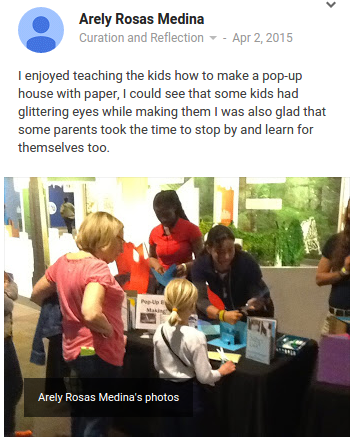
I continued,  “Students are writing reflections on what they had learned through the process of creating pop-up books.  You should definitely stay and see what this group of rising 9th graders can do.” I directed them to a counter, lined with carefully crafted books, each telling a story that mattered to students, and invited them to experience the students’ work. They browsed through the books, in awe of the craftsmanship and maturity of the content. As they read the books, which spoke to subjects including addiction, bullying, urban crime, sex trafficking, and genocide, subjects that students chose inquire into.  I also added that the students made videos of their books for publication on social media, arranged to have them put on display in the teen section of the public library, and planned on hosting a maker-faire in Discovery Place where they showed others how to create them.

Rightly so, they were impressed with what what they had seen.  But what they hadn’t seen, what was most important about what these students learned and composed, was the innovative space created in our public school over the last four weeks: the chaotic, organic, and connected experiences that students were writing so intently about.  This was the story that needed to be heard.  


Speaking quietly to this interested audience over the sound of clicking keys, I began to tell them the story of a classroom that looked very different over the last four weeks.  


-----


Over the last two years, I have been working with the science teacher on my interdisciplinary team, Tiffany Green, to incorporate experiences for students to make.  Open-ended experiences that encouraged students to produce, rather than consume, where students took the reigns to decide what to make, how to make it, and what content was important enough in their lives to make something about.  Though our curricular “content” was interwoven throughout each make, Tiffany and I also both knew that empowering students to make, regardless of where, or if, the content fit, worked at the heart of what each of our subjects was about.


As a Language Arts teacher, I saw make fitting in perfectly with how we use literacy to reconstruct our world.  It was an act of composition, with words and images. An authentic experience in negotiation and revision. And for Tiffany, make represented the process of doing real science, the sort where you explore and tinker with the world to figure it out.  We both wanted our students to be makers.  We wanted them to develop these skills and habits of mind fundamental to working and learning in our respective fields, yes, but more importantly we wanted them to have a school experience that developed their sense of agency and empowered them to engage with their worlds.  With the support of the other like-minded UNC Charlotte Writing Project Teacher Consultants and other and their students, that’s exactly what we did.


The idea we had with making pop-up books represented an approach we hadn’t before tried, around a medium that neither of us knew much about.  But pop-up books interested us, and felt like a nice fit into what we wanted students to explore through make. They’re a genre typically found in children’s hands, but the construction of them is more than childsplay.  It’s math, it’s science, it’s writing, it’s art.  It’s paper engineering a story and a great medium to convey a message just to be read, but experienced.


The Make, part 1--The Set-up


The project grew out of novels students were reading in my 8th grade ELA class. The novels, 20 AYA titles that in some way fell under the broad theme of injustice, were read by students in small book club groups, or literature circles.  Towards the conclusion of their novels students brainstormed themes and subject matter related to the text that they felt was important to their lives and/or community, and used this area of interest as a starting place for both research and creative writing. Writing that students would riff off for the storyline that would guide the books they would soon be engineering.


Building a pop-up book required students to be able to do more than write a compelling narrative; they would also need some familiarity with the mechanisms commonly employed while creating them.   Robby Stanley, the Make Embassador from Discovery Place, and self-taught (over the two weeks prior to this project) paper engineer, collaborated with Mrs. Green to transform her classroom for a few days into a paper engineering workshop.  With plenty of scrap paper, scissors, and markers on hand, the two teachers guided students as they worked through iterations of each of the four mechanisms commonly used in pop-up books: pull tabs/sliders, flaps, layers, fold-outs, and wheels.


Pull Tabs
Flaps
Layers
Fold-Outs
Wheels


There was a spirit of play that pervaded the classroom as students tinkered with the craft of paper engineering.  Each day, Robby demonstrated the approach to making a different mechanism, but that didn’t necessarily mean that a student was bound to master it that day.  Some would use their time to continue to refine a mechanism introduced the previous day, gaining assistance from Robby, Tiffany, or a classmate if they needed it. Other students used this time to explore, perhaps decorating the mechanism they created and figuring out what moving paper could enable in their art. Others used this time to invent, to modify an mechanism for a new purpose or play with combining mechanisms to make them work together.  


And when a mechanism didn’t function as it was supposed to, which in most cases it did not the first time through, students were encouraged to figure out why.  Robby encouraged this on the first day, telling students that they were engineers, and the job of engineers could be summed up in two words: “solving problems.” Students folded and cut, refolded and recut.  Early iterations were piled on a table in the back, and students frequently went back to this table to pull out scraps to try out something they weren’t sure of, or repurpose what another had discarded.
Learning about Learning
Through this low-stakes, playful paper engineering workshop, students learned the basics of the craft, and just as importantly, they learned about learning.  They began to re-see the importance of just diving in, even if the first try doesn’t work out.  The developed a playful attitude towards discovery and learned what it means to tinker, to play with materials without knowing what they will become. and to persevere and solve problems.  In itself, Robby and Tiffany’s paper engineering workshop was an experience that mattered, but what made it more than a successful experience, what made it powerful was what came next: the opportunity for students to put all of these skills and awakened habits of mind to use to compose and speak into their world through building a pop-up book.


Make Part 2--Composing Workshop


On the days while students tinkered with paper in Science class with Robby and Tiffany, in my class they were  finishing and sharing their creative writing pieces, negotiating collaborative groups and the stories that their books would feature, and beginning to storyboard the individual pages. And at this point, I stepped out of the way and gave over the control, and for the first time, making this book felt less like a project and more like a make.


While all students were creating a similar form, how they crafted that pop up book--from the story it told, the pop-up mechanisms it employed, the ways illustrations supported and interacted with both, was up to them.  What was also up to them, and perhaps the greatest challenge, was how they figured out how to make this all happen as a group. It was a process of constant negotiation and iteration. It wasn’t neat or easy, and fraught with unexpected challenges and frustration. In other words, it was a space that was rich with learning.


While it wasn’t uncommon for students to add a page they started to the scrap table because it didn’t work out they way they had envisioned, as the week went on, it also became more common for students to go back to this scrap table and build prototypes models of the before working on the actual page of the book.  And it seemed that the more students iterated, the more they also innovated.  They also began branching out from the models Robby had shown them.  Students combined mechanisms, for example, integrating a slide into a wheel.  They searched youtube and discovered more complex ways to engineer paper.  And they even played around with introducing new materials into their book, like string, duct tape, and electronic circuits made from led lights, copper tape, and coin-cell batteries.  


The cycle continued and grew, and with it students’ excitement and investment. The week I had set aside for students to make was nowhere near enough, nor was the extension I gave.  By the time we came to the new deadline we agreed upon, students books resembled something far different, and greater, than what they initially conceived.


It was the most rigorous experience with composition that has ever taken place in my classroom.                                                                                                                                                                                                                                                                                                                                                                                                                                                                     


-----
Writing and Making our World
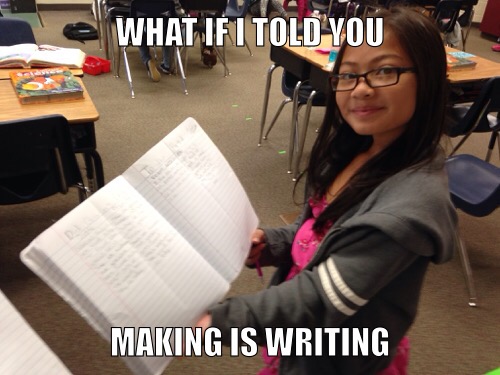
This group of administrators seemed content as they left my room on what was a much longer stay then I’m sure they envisioned. They seemed excited about the work that was happening, One commented on the way out that it was great to see students who took writing so seriously.  I understand why she said this.  The level of involvement of my students in their writing was uncommon. I hope, though, that something that she and the rest of my visitors took away was was the importance of our informal makerspace for student writers.   Writing is, of course, making, and making, minus the printed words, is no different than writing. Some of this I saw to be true as students made their books, but confirmed it when they put words on the page about the process afterwards. My students didn’t have to take time to collect and formulate their thoughts into words, the heart and most challenging part of writing, because they had already done so while making.  They could write deeply, because they had deep experiences to write from. And, what facilitated the process further, something that I have believed for some time to be true, is that since students were so accustomed to the just dive in there and figure-it-out-as-you-go, risk-taking, tinkerers’ spirit of Make, there was no hesitation on their part to do this with their writing.  


My students wrote like makers, and while this scene provided a powerful image for a group of administrators to see, I hope that it’s not the only one they are leaving with. I hope that they are also leaving with an image of just why make matters so much in school. Too often in teaching we are pressured to focus heavily on teaching content rather than teaching students; on students consuming, rather than producing; and having standards and assessment data drive instruction, rather than students’ own interests and purposes. Make represents an approach and underlying belief system that is much different, one that empowers the student and would not be possible if the teacher was not empowered and trusted as well. I want these administrators to pat themselves on the back for entrusting Tiffany and I to do this work. Like our students, we are left the experience excited and empowered, with a sense of being closer to the community and feeling the agency that comes from being able to make our world.  

By Steve Fulton